
sourcing / BUYER DESK
Electric Ride-On Wholesale: Approve Carton Data
Published 2026-11-07 · Updated 2026-11-07
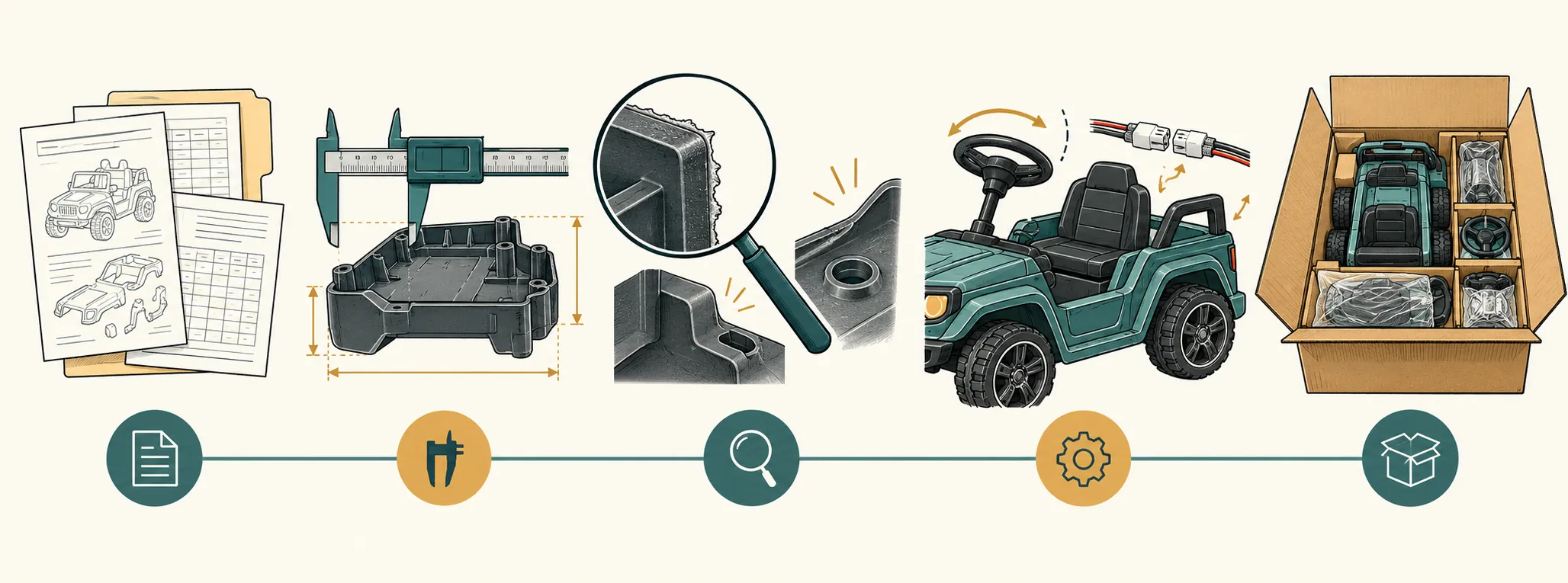
Approve carton data for an electric ride-on wholesale program only for a named product configuration, packing revision and sourcing stage. Use one worksheet to compare the catalog reference, agreed packing target and final closed-carton observations before authorizing the next step. For an electric motorcycle assortment, carton packing and a one-unit-per-carton reference provide a starting point—not final shipping measurements. Keep dimensions, units, weights, carton count, strength evidence and shipping marks together, with discrepancies assigned to an owner.
The practical outcome is a bounded decision: proceed with a quotation or sample request, approve the final carton record, or hold the affected item for correction. Carton approval does not replace product-safety release.
Which record should control each carton-data decision?
Use the catalog for preliminary planning, an accepted packing specification for the target, and final packed measurements for shipment reconciliation.
Before the purchase order, request proposed outer-carton dimensions with units, gross and net weight definitions, units per carton, packing construction and shipping-mark artwork. Identify the vehicle configuration and packing revision: a change in assembly position, accessories or internal supports can change the packed result.
At final packing, compare actual closed cartons with that accepted target. Then reconcile the packing list to the observed carton types, counts, weights and volume. Do not overwrite the original catalog reference; retain the approved revision and explain the change.
Agree dimensional and weight tolerances before inspection. A difference within an accepted tolerance can be approved, while a change that affects the buyer's storage or transport limit may need a revised packing decision. A discrepancy is a reason to investigate, not automatic proof that the shipment has failed.
Carton-Data Handoff Worksheet
Keep one worksheet per SKU and pack configuration, with separate entries for the catalog value, sample or quotation value, status and decision note. The electric motorcycle reference below illustrates how to populate the catalog column without treating it as a final inspection result.
The catalog reference is dated October 9, 2026. Use confirmed, open or conflicting for each field, and state what the status applies to: a catalog entry can be confirmed as recorded while its final packed measurement remains open.
| Product identity and packing revision | Catalog value: Electric Motorcycle Ride-On; SKU ROW-353501. Sample/quote value: enter the supplier's matching item reference, agreed vehicle configuration and packing revision. Status: confirm the identity match. Decision note: do not transfer carton approval to a different configuration without reviewing its packing. |
|---|---|
| Source and observation references | Catalog value: October 9, 2026 catalog reference. Sample/quote value: enter quotation revision, packing specification revision, sample or lot identifier, carton identifiers and inspection date. Status: confirmed when each observation can be traced to its record. Decision note: keep superseded versions available. |
| Outer-carton dimensions and units | Catalog value: size recorded as 85 × 42 × 58. Sample/quote value: obtain an explicit L × W × H statement, measurement units and confirmation that it describes the closed outer shipping carton; record final measured values separately. Status: open until the dimensional basis is established. Decision note: do not assume that an unlabeled size string is a centimeter carton measurement. |
| Gross and net weight | Catalog value: G.W. 6.65 kg; N.W. 5.55 kg. Sample/quote value: record the agreed weight definitions, final closed-carton scale reading and supporting net-weight record. Status: confirmed only for the stated configuration and basis. Decision note: investigate a difference beyond the buyer-agreed tolerance before updating the packing list. |
| Units per carton | Catalog value: 1 unit per carton. Sample/quote value: confirm the packing configuration and reconcile its pack-out record with the carton label. Status: confirmed when the records agree. Decision note: exterior marks alone do not establish the contents of a sealed carton. |
| Packing construction and strength | Catalog value: carton packing. Sample/quote value: record the agreed board construction, strength criterion, closure method, internal-support reference and supporting packaging evidence. Status: open until the agreed requirements are reviewed. Decision note: visible condition checks supplement, but do not establish, rated carton strength. |
| Carton count and packing-list totals | Catalog value: 1 unit per carton is the packing reference. Sample/quote value: enter planned and actual carton counts by carton type, then reconcile the corresponding unit totals with the packing list. Status: confirmed when counts and records agree. Decision note: resolve shortages, duplicate carton numbers or mixed packing revisions before approval. |
| CBM per carton and shipment volume | Sample/quote value: retain proposed volume separately from volume calculated using final outer dimensions; record carton count for each size. Status: confirmed when the calculation and count reconcile. Decision note: calculate different carton sizes separately before adding their volumes. |
| Shipping marks | Sample/quote value: attach the approved mark artwork and readable photographs of actual marks, including the agreed item reference, quantity, carton numbering and handling information. Status: conflicting if actual marks differ from the approved version. Decision note: correct the affected labels and retain correction evidence. |
| Decision, responsibility and closure | Record the stage being approved, decision, conditions, responsible approver and approval date. For each open or conflicting field, assign an action owner and due date. Close the item with a corrected record or recheck result, reviewer and closure date; reference the revised worksheet. |
How should the closed shipping carton be inspected?
Inspect identity and condition first, measure the closed carton next, and reconcile the resulting figures before accepting the packing list.
Match each selected carton to the worksheet's item and packing revision. Photograph the shipping marks, closure and visible condition. Look for crushed corners, wet areas, split seams, open tape or displaced straps. Compare these observations with the agreed packing specification; isolate affected cartons for review or repacking rather than averaging their condition into the lot.
Measure the external length, width and height on the fully packed, closed carton without compressing it. Record units, orientation, carton identifier and any bulge or protrusion that changes its shipping envelope. Compare the result with the accepted dimensional target—not merely the catalog string. If it falls outside the agreed tolerance, remeasure, check the packing revision and decide whether to repack or approve a revised target.
Weigh the same carton using a scale suitable for its weight range and record the reading in kilograms. Compare gross weight with the agreed record. Net weight needs a defined supporting measurement or pack-out record; it cannot be established by weighing the sealed carton alone.
For strength, compare the agreed construction and strength evidence with the packing revision being used. A carton that looks intact has passed a condition observation, not a compression-strength test. Any specified packaging test should be assessed against its agreed method and acceptance criterion.
Finally, reconcile carton numbering and physical counts with the packing list. Keep destination-specific paperwork separate from this physical carton review.
Hypothetical Packed-Carton Check
A dimensional difference can be acceptable while the final handoff still remains on hold for a labeling correction. The following figures and outcomes are hypothetical buyer-defined examples, not measurements of the catalog motorcycle.
Assume an accepted packing target of 90 × 45 × 60 cm, 40 cartons and one unit per carton. For this example only, the buyer permits up to 1 cm above target on each dimension. That allowance is a purchasing criterion, not a legal or industry standard.
| Dimensions | Record: accepted target 90 × 45 × 60 cm. Observation: closed carton measures 91 × 45 × 60 cm. Discrepancy: length is 1 cm above target. Decision: accept under the hypothetical agreed allowance, provided the measured envelope also meets the buyer's stated handling limits; use actual dimensions for final CBM. |
|---|---|
| Carton count | Record: packing list specifies 40 cartons at one unit per carton. Observation: physical count and carton numbering reconcile to 40 cartons. Discrepancy: none observed in the count. Decision: accept the count reconciliation; retain the supporting pack-out record for units per carton. |
| Shipping marks | Record: approved artwork identifies the current packing revision. Observation: inspected marks show the superseded revision. Discrepancy: label-version conflict. Decision: hold carton-data release for the affected cartons, correct the marks and verify the correction. |
| Approval and follow-up | Decision: dimensions and count accepted for this hypothetical check; final carton-data release remains conditional on mark correction. Record the packing reviewer's name and date, correction owner and due date. Close the condition only after the corrected marks are checked and the closure reviewer and date are entered. |
How is final carton CBM calculated?
Calculate CBM from the final outer-carton dimensions in centimeters, then multiply by the number of cartons with that exact packing configuration.
The formula is L(cm) × W(cm) × H(cm) ÷ 1,000,000. In the explicitly hypothetical example above, 91 × 45 × 60 ÷ 1,000,000 = 0.2457 m³ per carton. For 40 identical cartons, 0.2457 × 40 = 9.828 m³.
The proposed 90 × 45 × 60 cm packing would instead total 9.72 m³ across 40 cartons. Accepting the dimensional difference does not justify leaving the proposed volume on the final packing list. Update the measurement-based total. If pallets or other external packing are added, record that additional shipping envelope separately.
When should the buyer approve, hold or reject the handoff?
Approve only the named next step when the evidence needed for that step is satisfactory; keep unresolved final-packing questions attached to later release conditions.
For a quotation or sample request, proceed with clearly identified packing questions and a deadline for answers. Do not require final production-carton measurements before they can exist. For final carton-data approval, require the accepted target, observations and packing-list totals to reconcile, with exceptions explicitly approved.
Hold the affected approval when a critical unit, count, weight basis, strength requirement or shipping mark remains unresolved. State the exact correction and who must close it. Reject the proposed packing arrangement when it cannot meet the buyer's agreed handling or strength requirements and no acceptable revision is approved.
A completed worksheet supports traceability; it does not by itself reveal an undisclosed packing change. Retain physical observations and revision references alongside the decision. Product-safety testing remains a separate release check, and carton approval must not be presented as a safety certification.