
sourcing / BUYER DESK
Electric Ride-On Wholesale: Which Accessories to Approve?
Published 2026-11-15 · Updated 2026-11-15
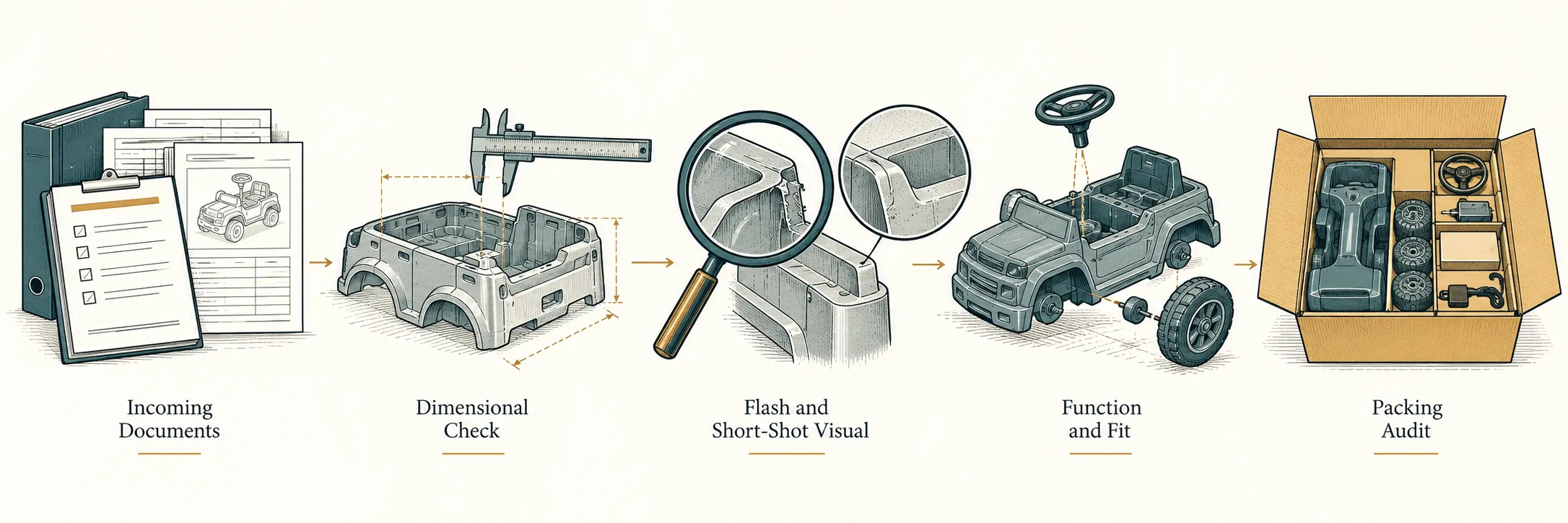
Approve an electric ride-on accessory only for the exact vehicle configuration it fits; hold unresolved matches and exclude confirmed mismatches or items outside the program’s scope. For electric ride-on toys wholesale programs, a go-kart charger and an ATV charger need separate approval lines until shared compatibility is established. Anchor each line to a vehicle platform, representative source SKU, configuration revision, and carton reference, then record the specified target, observed result, decision owner, and closure date before releasing it for purchase.
Which accessories should enter the program list?
Include accessories that support a defined vehicle use, replacement need, or approved assortment option—not every item that can be attached to a ride-on.
Keep the platform field within the four procurement collections: Electric Cars & SUVs; Electric Motorcycles & ATVs; Drift, Go-Kart & Racing Rides; and Construction & Specialty Rides. Then identify the exact vehicle model and configuration. A collection organizes the assortment; it does not establish interchangeability.
Treat a replacement battery or charger as an electrical matching decision. Specify the battery system, charging requirements, connectors, polarity, mounting or retention arrangement, and relevant model-specific documentation. Do not approve a charger because its plug fits.
For wheels, trim, or other mechanical accessories, compare the attachment interface, dimensions, retention method, and clearance on the intended vehicle. A remote control needs a receiver and function match, not merely a similar button layout. These are candidate accessory types, not claims that a particular vehicle supports them.
Battery, motor, remote-control capability, color, packaging, and licensing remain configuration attributes or approval questions. Do not create duplicate platform categories for them.
When should an accessory be confirmed, held, or excluded?
| Confirmed — release within the recorded scope | The accessory identity and revision are defined; observations meet the specified fit and function criteria; relevant document checks are complete; and the responsible approver has signed and dated the release. Limit approval to the named vehicle configuration and intended use. |
|---|---|
| Hold — retain the candidate without releasing it | A consequential fit, function, packaging, commercial, or document question remains open. State the exact closure condition, assign an owner, and set a target date. A hold is not evidence of supplier inability. |
| Exclude — remove from the approved purchasing scope | Inspection establishes a mismatch, the proposed change conflicts with the approved configuration, or procurement decides the accessory is outside the program. Record the reason and decision date. Reconsider only through a new review or revision. |
Which fields belong in the controlled accessory worksheet?
| Line identity and revision | Accessory line ID; list revision; accessory description; accessory part number and revision; proposed role such as included item, optional add-on, or service replacement. |
|---|---|
| Platform and representative source SKU | Procurement collection; vehicle type; representative vehicle source SKU; exact vehicle configuration or revision covered by the proposed approval. |
| Catalog anchor | Catalog snapshot date and source reference; recorded vehicle name; relevant packing fields. Label these as catalog records rather than sample observations. |
| Specified target | The approved drawing, specification, or configuration revision and the acceptance criteria for the accessory’s electrical, mechanical, or control interface. |
| Verified configuration and observation | Sample identity and revision; label photographs; measured or observed interface details; functional observations; reviewer and observation date. Record results against the target rather than writing only “checked.” |
| Carton reference | Parent-vehicle packing reference plus the accessory’s approved packing revision, location, and quantity. Distinguish an accessory packed inside the vehicle carton from one shipped separately. |
| Reference MOQ and current commercial basis | Keep the vehicle’s historical reference MOQ separate from the current accessory quotation, quoted MOQ, price, and packing terms. Do not transfer vehicle terms to a replacement part. |
| Status, reason, and release conditions | Confirmed, hold, or exclude; concise reason; any conditions that must close before purchase release. |
| Next action, owner, and target date | One specific action, the person responsible for completing it, and the agreed completion date. |
| Approval and follow-up closure | Responsible approver; decision date; release scope; closure evidence reference; person accepting closure and closure date; link to any superseding revision. |
How should the worksheet separate a go-kart charger from an ATV charger?
| Proposed go-kart replacement-charger line | Platform: Drift, Go-Kart & Racing Rides. Representative source SKU: ROW-353577. Recorded vehicle: Electric Go-Kart Ride-On. Catalog anchor: October 9, 2026, source asset 9848. Carton reference: vehicle carton packing, one vehicle per carton. Vehicle reference MOQ: 30, subject to current quotation. Specified target: charger matched to the approved vehicle battery system, charging requirements, connector, polarity, and intended destination. Status: hold. Next action: product engineer to record charger identity, compare specifications, and inspect the matched sample; procurement to obtain accessory-specific packing and quotation terms. Approval: procurement lead after technical review, with decision date and closure evidence entered before release. |
|---|---|
| Proposed ATV replacement-charger line | Platform: Electric Motorcycles & ATVs. Representative source SKU: ROW-353530. Recorded vehicle: Electric ATV Ride-On. Catalog anchor: October 9, 2026, source asset 9848. Carton reference: vehicle carton packing, one vehicle per carton. Vehicle reference MOQ: 30, subject to current quotation. Specified target: charger matched to this ATV’s approved battery system and charging interface, independently of the go-kart line. Status: hold. Next action: product engineer to check the ATV configuration and matched charger sample; procurement to confirm whether the accessory is packed separately or with the vehicle. Approval: procurement lead after technical review, with an assigned target date and documented closure. |
What would justify one shared accessory across both platforms?
Approve a shared accessory only when the same accessory revision satisfies the acceptance criteria for both named vehicle configurations.
For the charger example, compare the battery charging requirements and charger specifications, not just nominal voltage or connector appearance. Record the electrical interface, polarity, charging behavior specified for the battery system, and the model coverage of relevant documents. A physical plug-in check alone is not an electrical safety assessment.
If both matches are established, link the two vehicle lines to the same approved accessory identity while retaining each vehicle-specific approval. If one match remains open, release only the supported pairing. If a mismatch is established, exclude that pairing rather than rejecting the accessory for every platform.
The same logic applies to mechanical parts: an apparently identical wheel still needs its mounting interface and clearance checked on each intended configuration.
Who can release an accessory line, and against what?
Have the procurement lead release the line against a named specification revision after the designated technical reviewer has accepted the relevant observations.
Begin with the accessory’s job and target vehicle. Freeze the proposed accessory identity and acceptance criteria before reviewing the sample; otherwise, a convenient sample can quietly become the specification.
The technical reviewer records target versus observation and identifies any consequential deviation. Procurement then closes the accessory-specific quotation and packing questions. Route destination-document or licensing questions to the responsible reviewer when they affect the proposed line.
At the decision point, record confirmed, hold, or exclude; the approver’s name and date; and the exact release scope. A conditional decision stays on hold until the stated release conditions are accepted. Close each condition with an evidence reference, closure owner, and date—not merely a deleted comment.
Treat fit checks and routine functional observations as purchasing controls, not substitutes for applicable safety assessment or testing. An approval record supports traceability; it does not prove compliance or reveal an undisclosed substitution by itself.
Which changes should reopen an approved accessory line?
Reopen the affected approval when a change could alter the accessory’s fit, function, packing, or documented scope.
Review changes to the battery system, charging interface, controller or receiver, mounting geometry, accessory part revision, or vehicle configuration. A carton change also needs review when it changes the accessory’s packing location, protection, or quantity.
Preserve the earlier approval and identify what has changed. Recheck the affected criteria rather than automatically discarding every valid observation. For a color-only or artwork change, review the relevant finish or licensing question without assuming that an unchanged mechanical interface needs a complete new fit investigation.
Before the next purchase release, confirm that the order names the approved accessory and vehicle revisions and that any superseded line is clearly marked. This keeps the list useful as a purchasing decision record rather than a static catalog of possible parts.