
review / BUYER DESK
Drift Ride On Car Wholesale: Caster Geometry & Space Math
Published 2026-11-28 · Updated 2026-11-28
A distributor in Dallas is holding two 40HQ containers of ride-ons in the same colorway: a 1.10 m long low-slung drift platform with two rear caster wheels, and a 1.25 m tall SUV-style body on four fixed wheels. Both carry a 12 V pack and a 2.4 GHz remote. The SUV sells on silhouette; the drift car sells on the promise of a slide. Before either reaches a purchase order, the drift ride on car wholesale decision turns on three measurable items: rear-caster slip geometry, flat-pavement play-zone area, and a document set that survives a US customs file review.
This guide treats the drift platform as a structure-first SKU. Every dimension below is a placeholder until a model-level assembly drawing, carton reference and test report replace it. RideOnWholesale lists drift platforms inside its Drift, Go-Kart & Racing Rides collection alongside Electric Cars & SUVs, and the catalog does not claim factory ownership, fixed capacity, certified compliance, fixed price, universal age suitability, maximum load, speed or range without model-level evidence.
The payoff for buyers is a shortlist rule: a drift SKU is quote-ready when its caster geometry, play-zone math and CPC package line up on one page. Speed claims stay out of the conversation until those three items are verified.
Rear-caster slip geometry versus the tall SUV stance
A rear caster is an offset wheel that swivels about a vertical axis. When the chassis yaws, the caster trail converts forward motion into a sideways scrub at the rear contact patches. That scrub is the drift. It only reads as controlled play when the center of gravity sits low and the surface is flat, dry and bounded. A tall SUV-style body raises the center of gravity and runs four fixed wheels, so the same steering input produces a wider arc and a higher roll moment instead of a slide.
Gear-train design sets how that motion is delivered. gear activities describe the trade-off between speed and torque: a gear ratio chosen for top speed reduces the torque available to push the chassis through a slide, and a ratio chosen for torque limits top speed. For a drift platform, the useful question at quotation is the published gear ratio and motor rating on the model sheet, not a top-speed number in a listing title.
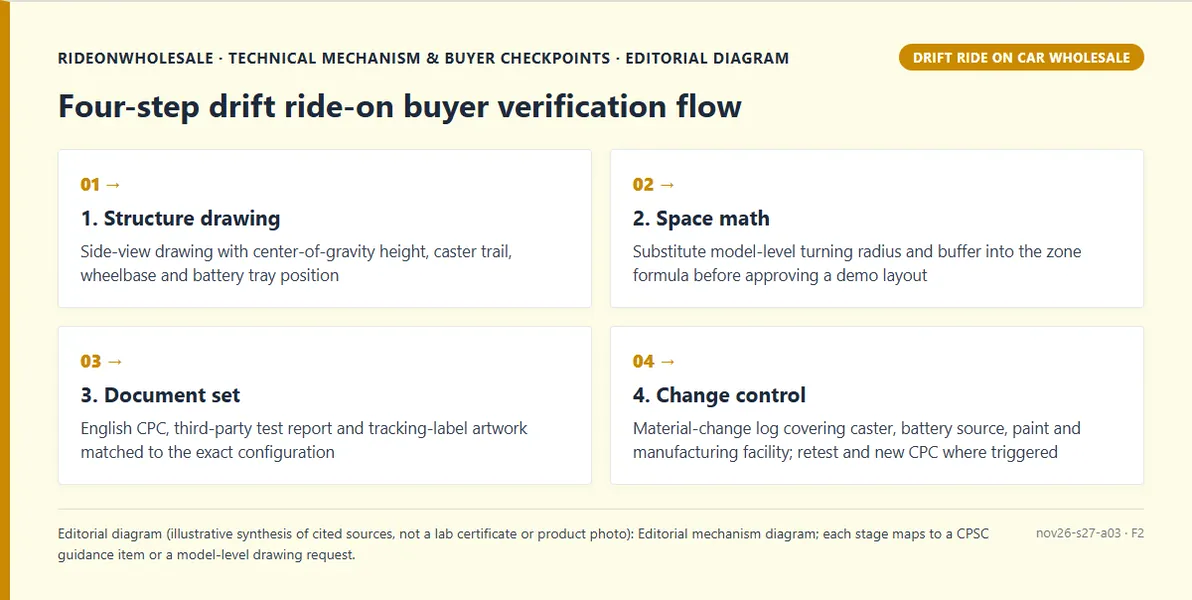
The structural evidence to request is a side-view assembly drawing that marks the center-of-gravity height, the caster trail dimension, the wheelbase and the track width, plus a chassis photo showing the battery tray position. A drawing that shows the battery mounted low and centered between the rear casters supports the low-slung claim. A drawing without those marks leaves the slip behavior unverified, whatever the catalog photo suggests.
Play value has a public-health backdrop worth one line in the buyer note. WHO reports that 86% of adolescents do not meet recommended physical activity levels and that physical activity in children and adolescents improves motor and cognitive development. A drift ride-on is a wheeling play product, and the play-zone layout is what keeps that play inside a boundary.
Flat-pavement space math: an illustrative play-zone calculation
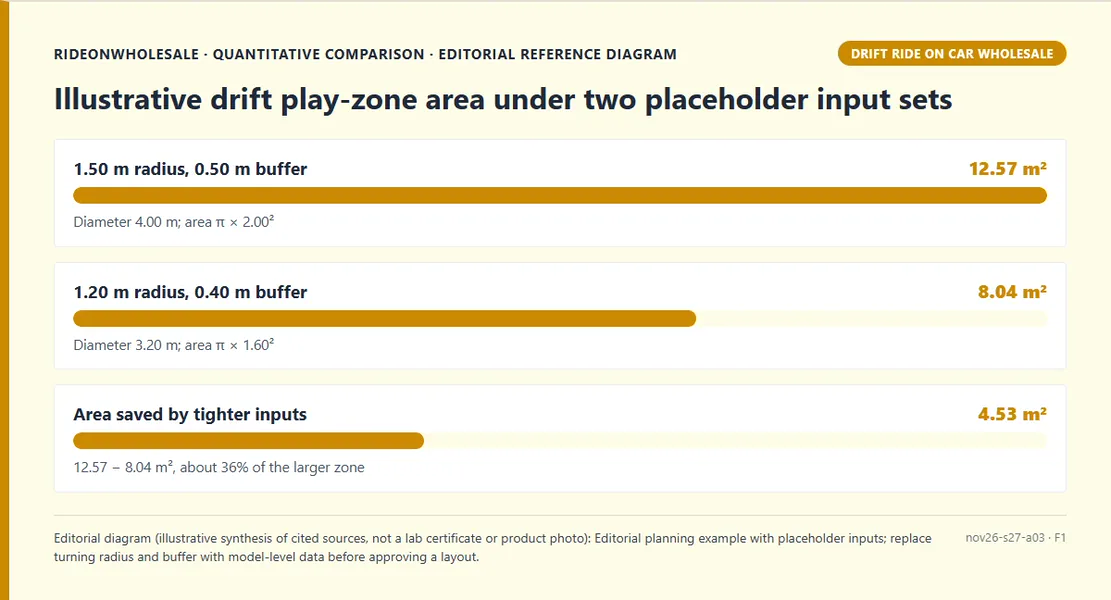
The following is an illustrative planning example, not a lab test and not a product specification. Inputs: vehicle length 1.10 m, vehicle width 0.65 m, minimum turning radius 1.50 m, and boundary clearance 0.50 m per side. All four are placeholders that a model-level drawing must replace.
Formula: play-zone diameter = 2 × (turning radius + boundary clearance); play-zone area = π × (diameter ÷ 2)². Substituting: diameter = 2 × (1.50 + 0.50) = 4.00 m; area = π × (2.00)² = 12.57 m². Under these placeholders, a bounded flat area on the order of 12–13 m² holds one drift car with a 0.50 m buffer on every side.
Now test the sensitivity. Drop the turning radius to 1.20 m and the clearance to 0.40 m: diameter = 2 × (1.20 + 0.40) = 3.20 m; area = π × (1.60)² = 8.04 m². A 0.30 m tighter turning radius and a 0.10 m thinner buffer cut the required area by 4.53 m², roughly 36% of the 12.57 m² case. That is why the turning-radius figure on the model sheet matters more than the body length for retail demo layouts.
Two practical readings follow. First, a 12.57 m² zone fits inside a 4.00 m × 4.00 m square only if the corners are rounded off or blocked; a rectangular pen of 4.00 m × 3.20 m gives 12.80 m² and clears the diameter on the long axis. Second, the boundary is a physical object, not a painted line: a 0.50 m buffer next to a curb, planter or fence absorbs the slide before the chassis reaches a hard edge. Buyers planning a store demo or a dealer open day should publish the zone dimensions on the floor plan and keep the surface flat, dry and free of gravel.
Drift platform versus tall SUV platform: buyer comparison grid
Each row names the evidence that closes the cell. Cells marked model-level are placeholders until a drawing, carton reference or test report arrives; no cell in this grid is a verified product specification.
| Attribute | Evidence required | Tall SUV-style ride-on | Drift ride-on (rear casters) |
|---|---|---|---|
| Chassis stance and center of gravity | Model-level assembly drawing with CoG mark and battery tray position | Raised body; center-of-gravity height marked on side-view drawing | Low-slung body; center-of-gravity height marked on side-view drawing |
| Rear wheel behavior | Caster part drawing plus chassis photo of the rear axle | Four fixed wheels; wider arc, no designed scrub | Two swiveling casters with marked trail dimension; lateral scrub on yaw |
| Turning footprint and play-zone area | Model-level turning radius; replace every placeholder input | Recompute with the SUV model's own turning radius and buffer | 12.57 m² at 1.50 m radius and 0.50 m buffer (illustrative) |
| Rider age and supervision framing | CPC citing applicable rules; label artwork with age and supervision text | Manufacturer-stated age plus adult supervision line; same CPC boundary | Manufacturer-stated age plus adult supervision line; CPSC 12-or-younger boundary governs CPC |
| Document set before quotation | English CPC and supporting reports matched to the exact configuration | CPC, third-party test report, tracking-label artwork, battery and charger identity | CPC, third-party test report, tracking-label artwork, battery and charger identity |
Rider age, supervision and the CPSC 12-or-younger boundary
Two age statements live on every drift ride-on carton and they are not the same statement. The first is the manufacturer's stated rider age and supervision line. The second is the US certification boundary: CPSC guidance states that third-party testing and CPC certification apply to products designed or intended primarily for children 12 years of age or younger, even though ASTM F963 covers toys intended for children under 14 years of age. A drift ride-on marketed to a 6–10 age band sits inside the certification boundary and needs the full CPC package.
The mandatory toy standard is ASTM F963 under 16 C.F.R. part 1250, and 16 C.F.R. § 1250.2 identifies the latest Commission-accepted version. The CPC must be written in English and rest on test results from a CPSC-accepted laboratory. A catalog page that prints a standards string without a matching CPC and report is not evidence of compliance.
Supervision framing belongs in the label artwork and the listing copy together. The American Academy of Pediatrics advises parents to read warning labels for age and use information and to check that electric toys are UL approved. For a drift SKU, the supervision line should state that an adult sets up the bounded flat zone and monitors the session, and the listing should repeat the same sentence so the retail page and the carton agree.
For EU-bound containers, the rule set changes. Toy Safety Regulation (EU) 2025/2509 was adopted on 26 November 2025, enters into force on 1 January 2026 and applies after a 4.5-year transition on 1 August 2030, with a digital product passport required for toys. A drift SKU sold into both markets needs two document tracks, and the US CPC does not substitute for the EU track.
Document checklist before a drift SKU enters the quote-ready shortlist
Item 1: an English CPC that names the exact drift configuration and cites each applicable children's product safety rule. Item 2: the supporting third-party test report from a CPSC-accepted laboratory, matched to the same configuration and date. Item 3: tracking-label artwork for the product and the packaging, showing manufacturer or importer name, location and date of production, batch or run number, and other source-identifying information; the tracking label is not itself a certifiable safety rule, so it sits in the packout confirmation rather than the CPC.
Item 4: a material-change log tied to the purchase order. CPSC defines a material change as a change to design, manufacturing process or component source that could affect compliance, and the firm must retest and issue a new CPC. A new caster, a new battery source or a new paint supplier each triggers that review. A change of manufacturing facility requires retesting and recertification of the entire product.
Item 5: battery and charger identity. CPSC reports recalls involving batteries used in battery-powered ride-on toys, with hazards including overheating, fire, electrical shock from chargers, thermal burns and high-velocity ejected internal components, and incidents during use, storage and charging. CPSC staff recommends testing the battery with the product in its intended use and with the charger as a system, plus a system approach covering thermal protection and charge and discharge protection. The quotation file should name the cell chemistry, the charger model and the protection features on the model sheet.
Do drift ride-ons need a Children's Product Certificate for the US market?
Yes. A drift ride-on designed or intended primarily for children 12 years of age or younger that is subject to a children's product safety rule requires third-party testing at a CPSC-accepted laboratory and a written CPC in English. ASTM F963 is mandatory for children's toys under 16 C.F.R. part 1250, and 16 C.F.R. § 1250.2 identifies the latest Commission-accepted version cited on the certificate.
How much flat pavement does a drift ride-on need?
Plan on roughly 12–13 m² per car under the illustrative inputs of a 1.50 m turning radius and a 0.50 m boundary clearance, which yields a 4.00 m diameter and 12.57 m² of bounded flat surface. Replace both inputs with the model-level turning radius and your chosen buffer: a 1.20 m radius with a 0.40 m buffer drops the requirement to 3.20 m diameter and 8.04 m².
What happens to certification if the supplier changes a caster or battery source?
The existing CPC stops covering the changed SKU. CPSC defines a material change as a change to design, manufacturing process or component source that could affect compliance, and the firm must retest the product or component at a CPSC-accepted laboratory and issue a new CPC. A new caster or a new battery source is exactly that kind of change, so the purchase order should pin the certified configuration by part number and revision.
Build the drift shortlist on structure, space and documents
Send the drift platform's side-view drawing, caster part drawing, carton dimensions, turning radius and current CPC package to the RideOnWholesale sourcing desk for a side-by-side review against the SUV platform. The catalog organizes drift, go-kart and racing rides next to Electric Cars & SUVs so buyers can compare platforms on one screen, and every price, MOQ, battery, speed, load, age, certification and delivery term stays quotation- or document-dependent until the model-level evidence arrives.
Sources
www.cpsc.gov — Batteries | CPSC.gov
www.cpsc.gov — Toy Safety Business Guidance | CPSC.gov
www.cpsc.gov — Children's Product Certificate | CPSC.gov
www.cpsc.gov — Tracking Label Business Guidance | CPSC.gov