
oem / BUYER DESK
How to Build an Electric Car & SUV Ride-On Buying Matrix
Published 2026-11-03 · Updated 2026-11-03
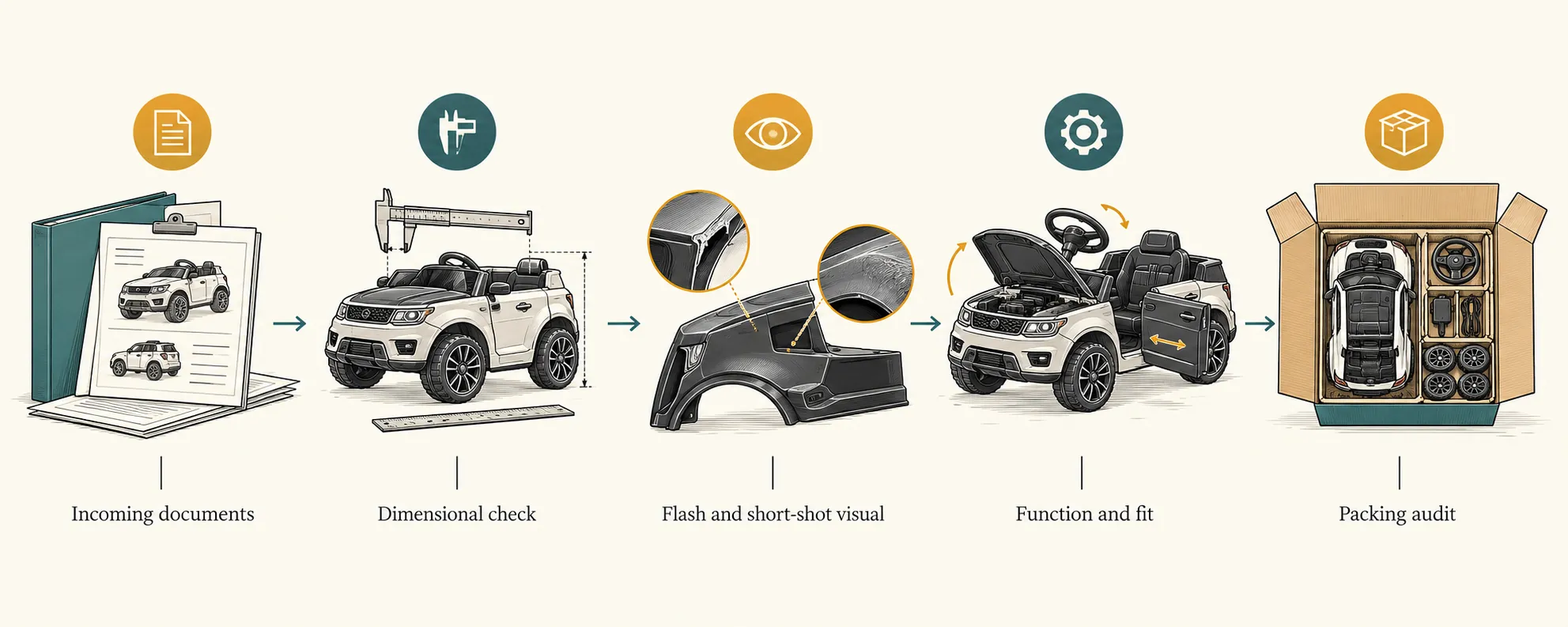
Build your electric ride-on car and SUV matrix with one row per SKU, market variant, and proposed configuration—not one row per vehicle body. For private-label electric ride-on toys, keep catalog facts separate from supplier-described equipment, then add your required specification, verification evidence, and buying decision. This structure lets you shortlist a vehicle without treating a shared model reference, a higher voltage, or a regional quotation label as proof that two offers are interchangeable.
What columns should the model-and-configuration matrix contain?
Use separate column groups for identity, recorded specifications, commercial terms, requested changes, and approval evidence. Keep the supplier's original configuration reference intact while also splitting voltage, battery, and motor into individual comparison columns.
A practical spreadsheet header is: vehicle category; product name; SKU; model/folder reference; full configuration reference; quote-market variant; intended destination; voltage; battery; motor; required features; recorded size; carton quantity; base catalog MOQ; reference price; requested private-label changes; current quote revision; sample ID; evidence status; decision.
Add verification status to each consequential attribute, not just to the whole row. A sample can demonstrate a light function while battery identity still requires inspection. Likewise, a confirmed quotation records what is offered; it does not establish what a production sample contains.
Which evidence status belongs beside each specification?
| Catalog-recorded | Preserve the listed identity, configuration text, size, packing, MOQ, and reference price. This status identifies the starting record, not an approved production specification. |
|---|---|
| Quote-confirmed | Record the supplier's confirmed specification, included equipment, quotation date, and revision. Tie the response to the exact SKU and market variant. |
| Sample-checked | Record the sample ID, check date, method, and actual observation for the relevant attribute. A functional demonstration does not establish speed, load capacity, or safety-test results. |
| Document-reviewed | Record the document reference and the construction, model, and destination scope reviewed. Do not treat a regional quotation label as certification evidence. |
| Buyer-approved | Record the accepted target, evidence considered, approver, date, and any conditions. Approval is a purchasing decision, not a substitute for the underlying checks. |
How should two SUV configurations be compared?
| Electric Off-Road SUV Ride-On — ROW-353559 | Category: SUV. Model/folder: DLS-X16. Quote-market variant: Europe and US. Full configuration reference: DLS-X16; 12V; battery 12V7AH x 1; motor 550 x 2; Europe and US quote variant. Recorded size: 123*77*67. Packing: carton; carton quantity: 1. Base catalog MOQ: 30. Reference price: USD 128.006. Evidence status: catalog-recorded; confirm electrical configuration in the current quote and match it to the sample. Proposed decision: retain as the 12V SUV candidate. |
|---|---|
| Electric Off-Road SUV Ride-On — ROW-353560 | Category: SUV. Model/folder: DLS-X16. Quote-market variant: Europe and US. Full configuration reference: DLS-X16; 24V; battery 24V5AH x 1; motor 555 x 2; Europe and US quote variant. Recorded size: 123*77*67. Packing: carton; carton quantity: 1. Base catalog MOQ: 30. Reference price: USD 137.913. Evidence status: catalog-recorded; confirm electrical configuration in the current quote and match it to the sample. Proposed decision: retain as the 24V SUV candidate. |
Which SUV configuration should advance to quotation?
Advance the 12V row when your assortment brief specifies a 12V SUV; advance the 24V row when it specifies a 24V SUV. If voltage is still a buying choice, request both quotations against the same feature and packaging brief so the comparison isolates the configuration difference.
Do not rank the 24V entry as faster, stronger, or longer-running from voltage alone. The listed motor references are not wattage ratings, and neither row establishes those performance outcomes. Put any required speed, load, or runtime into a separate target column and request supporting specifications and appropriate evaluation.
Keep the reference prices exactly as recorded until a current quote establishes the selling-unit basis and included equipment. The base MOQ of 30 does not establish a private-label MOQ or an order multiple. Carton quantity 1 is packing information, not an ordering restriction.
For the recorded size strings, request dimension units, dimension order, and confirmation of whether they describe the assembled vehicle or its packaging before using them for fit or freight calculations.
How should market variants of the same model be recorded?
| Space Planet Electric Bumper Car — ROW-353579 | Category: bumper car. Model/folder: DLS-K1. Quote-market variant: Southeast Asia. Full configuration reference: DLS-K1; 6V; battery 6V4.5AH x 1; motor 380 x 2; Southeast Asia quote variant. Recorded size: 67*67*40. Packing: carton; carton quantity: 1. Base catalog MOQ: 30. Reference price: USD 50.3326. Evidence status: catalog-recorded; confirm the current configuration and feature inclusions. Proposed decision: request this variant for a Southeast Asia quotation brief. |
|---|---|
| Space Planet Electric Bumper Car — ROW-353581 | Category: bumper car. Model/folder: DLS-K1. Quote-market variant: Europe and US. Full configuration reference: DLS-K1; 6V; battery 6V4.5AH x 1; motor 380 x 2; Europe and US quote variant. Recorded size: 67*67*40. Packing: carton; carton quantity: 1. Base catalog MOQ: 30. Reference price: USD 52.9865. Evidence status: catalog-recorded; confirm the current configuration and feature inclusions. Proposed decision: request this variant for a Europe or US quotation brief, naming the actual destination. |
Can features be copied between matching model references?
Do not copy features between rows solely because the model reference matches. The Southeast Asia bumper-car description lists breathing lights, music, Bluetooth, remote control, three-speed adjustment, and dual-drive. Treat these as supplier-described features to confirm for that variant, not as sample observations.
Request a feature-by-feature inclusion response for the Europe and US variant rather than carrying that list across automatically. Its different reference price does not identify which components, accessories, or documents account for the difference.
A shared model reference is useful for grouping candidates. It is not enough to approve substitutions between them.
How does the matrix become a precise private-label RFQ?
Issue one RFQ line per candidate row and require the response to preserve its SKU, full configuration reference, market variant, and requested revision. Ask the supplier to confirm or correct each specification rather than answering with another general product description.
Use this request for the selected row: “Quote the identified vehicle and configuration for the stated destination. Confirm voltage, battery rating and quantity, motor reference and quantity, and each required feature. Identify all deviations from our matrix and state the quotation revision and sample to which your response applies.”
For private-label work, attach the requested logo placement, color reference, packaging artwork, and manual language as buyer requirements—not assumed available options. Request feasibility, any configuration changes, customization MOQ, and revised commercial terms.
Ask the quote to identify the selling unit, included accessories, dimension units and basis, packing, and applicable order restrictions. Where age grading, load, speed, or destination documents affect your selection, request the specific declaration or evidence tied to the proposed construction.
What must the final configuration approval record capture?
| Identity and revision | Record the matrix row ID, SKU, model reference, full configuration, quote-market variant, intended destination, quote revision, sample ID, and artwork revision. |
|---|---|
| Specified target versus observation | For each critical attribute, enter the buyer's required value, supplier-confirmed value, sample observation, and supporting document reference where relevant. Record differences explicitly. |
| Decision and conditions | Choose approved, conditionally approved, or hold. State the accepted configuration, permitted deviations, and what must be resolved before purchase-order release or another specified milestone. |
| Responsible approver and date | Record the named buyer approver, approval date, and any separate technical or document-review sign-off required by your purchasing process. |
| Follow-up closure | Assign each outstanding condition an owner, due date, required evidence, closure date, and closure approver. Link any revised sample or quotation back to the affected row. |
When is a configuration row ready for the buying decision?
A row is ready when its identity is unambiguous, decision-critical specifications have suitable evidence, commercial terms describe the requested private-label scope, and remaining conditions have an explicit owner and release gate.
An unresolved attribute is not proof of a defect or noncompliance; it is a reason to limit what you approve. The matrix supports traceability, but it cannot by itself reveal an undisclosed component change. Preserve the approved specification and sample references, require proposed changes to be submitted for review, and check supplied goods against the agreed configuration.