
sourcing / BUYER DESK
How to Check Electric Ride-On Car & SUV Product Videos
Published 2026-11-06 · Updated 2026-11-06
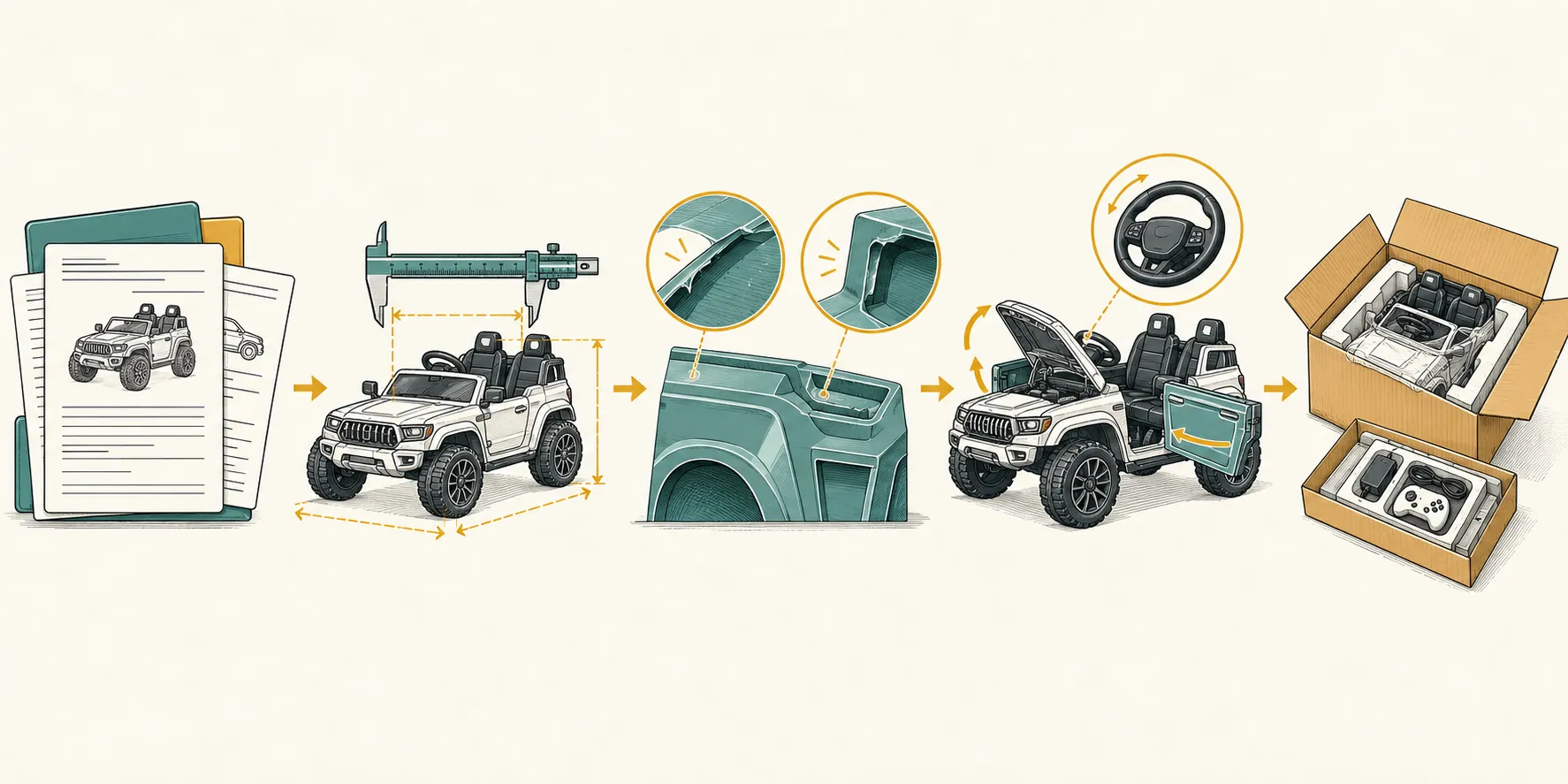
Check an electric ride-on car or SUV product video by matching the filmed unit to the quoted configuration, recording time-stamped observations, and separating visible operation from supplier claims. Advance to a sample only when product identity and the relevant visible details align; request targeted footage when they do not. A video can show body layout, accessible components, and a demonstrated movement sequence. It cannot establish battery capacity, durability, load rating, or safety compliance merely because those claims appear in captions.
Use the review as a sourcing gate, not an order approval. The electric forklift ride-on example below applies the same method to a construction-style vehicle; it is a forklift, not a passenger-car or SUV model.
What can you verify directly from a ride-on product video?
A product video supports observations about the particular unit and actions shown, while narration and captions remain claims to check against the quote, sample, or documents.
Record three things separately: the requested specification, what the camera actually shows, and what the supplier says. For example, a close-up may establish that the installed battery label reads 12V; it does not independently establish the battery’s actual capacity or condition. Likewise, a DLS08 caption identifies the supplier’s stated configuration, but does not prove that every component matches that configuration.
Useful visual evidence includes the vehicle’s overall shape, sit-on layout, wheel arrangement, visible seat attachments, battery-compartment access, and closure method. Watch a continuous operating sequence for starting, movement, steering, and stopping using the quoted controls. Note the surface, whether the vehicle is unloaded, and any cuts that interrupt the sequence.
Do not turn a brief drive into a runtime or durability finding. Visible movement is not a measured speed result, and forklift styling does not establish that the forks lift or carry a load. If working forks are included in the quote, review that mechanism separately without treating the demonstration as proof of lifting capacity.
Which catalog details should the filmed unit match?
| Product identity | Electric Forklift Ride-On; supplier item reference ROW-353499; product type: forklift. |
|---|---|
| Configuration reference | DLS08. Match this reference to the quote and the supplier’s filmed-unit identification. |
| Electrical reference | 12V. Request readable installed-component labels and an itemized battery and motor specification rather than inferring electrical details from the vehicle’s appearance. |
| Size reference | 146 × 63 × 101 cm. Request a measurement sequence that identifies the dimension order and measurement endpoints. |
| Packing reference | 1 unit per carton. Check the packing demonstration separately from the assembled-product footage. |
| Market quote reference | Europe and US quote variants. Identify the exact destination variant in the quote and confirm which variant appears in the footage; the market description is not proof of compliance. |
What footage should you request before completing the review?
Request footage that connects identification, close-ups, and operation to the same physical unit rather than accepting an edited montage as a configuration check.
Start with a walkaround showing the supplier’s unit identifier beside the vehicle. Ask for continuous transitions to the controls, seat area, wheels, and accessible component labels. Where separate clips are necessary, keep the same unit identifier visible and obtain confirmation that the unit and configuration have not changed.
For the battery compartment, request a powered-off opening and closing demonstration by the supplier’s technician, with clear views of the cover, fastening method, accessible wiring, connectors, and installed battery label. Do not request improvised electrical modifications for the camera.
Dimensions need a readable tape measure with both endpoints visible. Packing needs its own sequence showing the unit, loose parts, protective materials, carton markings, and closure. An assembled vehicle beside a sealed carton does not establish carton contents.
These are commercial screening requests, not safety tests. Clear footage improves traceability and identifies sample checks; it does not by itself prevent or expose an undisclosed component change.
Electric Forklift Ride-On Video-Review Worksheet
| Review identity and approval | Record the supplier item reference, filmed-unit identifier, configuration and revision, destination variant, video filename/version and filming date, quote number/revision, reviewer and review date. Add the responsible approver, approval date, decision, and any release conditions. |
|---|---|
| Product identity and quoted variant | Target: the quoted electric forklift ride-on in DLS08 configuration. Observation: record the walkaround timecode, visible identifiers, and supplier confirmation linking the filmed unit to the quote. Flag a different body, controls, component layout, or unconfirmed revision. Follow-up: obtain identification footage or a written variant reconciliation before accepting the clip as representative. |
| Voltage and component labels | Target: 12V system and components matching the itemized quote. Observation: transcribe readable installed labels and record their timecodes; list caption-only specifications separately. Flag conflicting voltage or component references. Follow-up: obtain sharper label footage, the component specification, or a corrected quote; verify the sample against those records. |
| Dimensions | Target: 146 × 63 × 101 cm, with dimension order and endpoints confirmed. Observation: record each filmed measurement and timecode. Flag measurements that differ from the agreed drawing or omit an endpoint. Follow-up: request a complete measurement sequence and resolve whether the difference comes from measurement convention or construction. |
| Sit-on layout and forklift features | Target: the quoted sit-on forklift styling and controls. Observation: identify the seat, control positions, fork assembly, and any demonstrated mechanism. Flag a quoted function shown only in narration. Follow-up: request a close-up demonstration of that function and include it in the sample inspection. |
| Battery access and closure | Target: the access and fastening arrangement agreed for the quoted construction. Observation: record the powered-off opening, installed label view, wire routing, and completed closure. Flag an obscured fastening point or a cut that skips closure. Follow-up: request the missing view and inspect access, fit, and fastening on the sample. |
| Wheel, chassis, and seat details | Target: visible construction consistent with the quoted unit. Observation: record close-ups of accessible mountings, wheels, underside, seat attachments, and visible damage or movement. Do not infer load capacity or long-term strength. Follow-up: mark the specific attachment or assembly for sample inspection. |
| Basic operation | Target: a continuous demonstration of the functions included in the quote. Observation: record start, movement, steering, stopping, surface, load state, and interruptions. Flag a cut that conceals the action under review. Follow-up: request an uninterrupted repeat; reserve measured performance and electrical checks for the sample evaluation. |
| Packing | Target: 1 unit per carton with the quoted included parts. Observation: record the packing sequence, contents, protection, and carton markings. Flag a mismatch between the demonstrated contents and packing list. Follow-up: reconcile the packing list and inspect the packed sample. |
| Follow-up closure | For each open item, record the required replacement clip, document, quote correction, or sample check; assign an owner and due date. Close it with the evidence reference, resolution, closure date, and approver. Keep the original observation so the decision remains traceable. |
How would two different clips change the sourcing decision?
| If the clip shows the body and driving, but specifications appear only in captions | Observation: forklift styling, sit-on layout, and the filmed movement are shown; installed labels and filmed-unit revision are not shown. Result: needs follow-up for configuration matching, not an electrical-specification pass. Next action: request unit identification, readable component-label footage, and confirmation linking the filmed revision to the quote. |
|---|---|
| If identification, installed labels, measurements, and continuous operation align with the quote | Observation: the filmed unit is linked to DLS08, the visible voltage label matches 12V, measurements use agreed endpoints, and the requested operation is shown. Result: pass for the defined video-screening criteria only. Next action: request a sample tied to the reviewed configuration, then check component specifications, assembly, measured functions, packing, and relevant documentation. |
When should you request a sample, ask for another video, or stop?
Request a sample when identity and relevant visible details align, ask for targeted footage when a review criterion remains unclear, and stop advancing the item when a consequential mismatch remains unresolved.
Advance to sample: the filmed unit is linked to the quoted revision, requested visual checks are complete, and no unresolved discrepancy blocks evaluation. Make the sample request identify that configuration and list the remaining physical, electrical, performance, packing, and document checks. A good video does not replace sample evaluation or applicable safety testing.
Request another clip or a quote revision: the camera omits a label, measurement endpoint, closure, or operating step, or the supplier confirms that the footage shows a different variant. Name the exact shot or correction needed. An omitted view alone does not prove a defective product or supplier dishonesty.
Stop or reject the candidate: a confirmed construction difference fails your purchase specification, or clarification does not resolve a material conflict between the filmed unit and the offered configuration. Record whether you are rejecting the video as representative evidence or rejecting the product itself; those are different decisions.
Close the review with the decision, conditions, responsible approver, and date. Keep any unresolved sample checks attached to the handoff rather than allowing a video-screening pass to become an unconditional purchase approval.