
sourcing / BUYER DESK
How to Define Electric Ride-On Packout Before Quoting
Published 2026-11-16 · Updated 2026-11-16
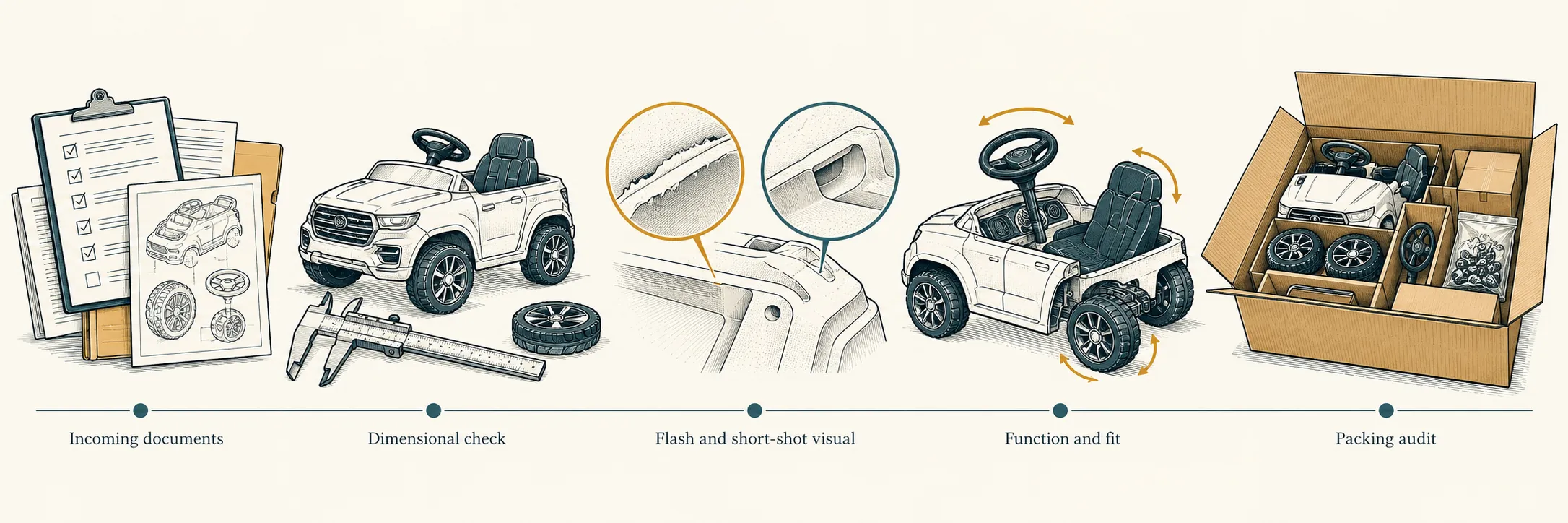
Define electric ride-on packout as the exact vehicle configuration, assembly state, included contents and protective packaging covered by the quote—not just a carton count. For an electric ride-on toys wholesale program, give each representative platform a revision-controlled worksheet linking those choices to its carton reference and current measurements. Send unresolved choices as explicit questions with the quote request; approve the final quote only after the choices affecting its packed contents, dimensions, weight or price are settled.
An electric motorcycle and an electric drift car are different assortment platforms. Neither the product name nor “one unit per carton” establishes whether wheels, steering parts, a battery, a charger or accessories arrive installed, separately packed or excluded. Specify that physical arrangement before treating two offers as equivalent.
What Do the Motorcycle and Drift-Car Records Establish?
| Platform and representative reference | Electric Motorcycle Ride-On: ROW-353495. Electric Drift Ride-On Car: ROW-353510. |
|---|---|
| Recorded packing | Motorcycle: carton. Drift car: carton. |
| Recorded units per carton | Motorcycle: 1. Drift car: 1. |
| Source size reference | Motorcycle: 115 × 38 × 70. Drift car: 122 × 71 × 62. |
| Recorded gross weight | Motorcycle: 18.0 kg. Drift car: 21.7 kg. |
| Recorded net weight | Motorcycle: 15.4 kg. Drift car: 17.6 kg. |
| Next buyer decision | Create separate packout definitions for these platforms. Confirm each vehicle configuration and packed arrangement before accepting its size and weight references as quote terms. |
Which Products Need Separate Packout Definitions?
Use a separate packout definition whenever the platform or selected variant changes what is packed, how it is arranged, or the carton and weight basis.
Start with a representative product from each collection included in the program: Electric Cars & SUVs; Electric Motorcycles & ATVs; Drift, Go-Kart & Racing Rides; and Construction & Specialty Rides. Record why it represents the proposed assortment—shared platform, assembly arrangement or carton family. A collection name alone is not evidence that its products share a packout.
Variants may share a worksheet only when the supplier confirms the same packing arrangement and the worksheet explicitly identifies the covered variants. List colors as variants rather than creating duplicate procurement categories. Separate a variant if its accessories, installed equipment, protective packing or carton differs.
What Should the One-Page Packout Worksheet Contain?
| Product identity and revision | Record the product name, supplier SKU, buyer item reference, collection, reason for representation, covered variants, worksheet revision and issue date. Link the quote number/revision and sample identifier when assigned. |
|---|---|
| Catalog baseline | Copy the dated catalog packing type, units per carton, source size and gross/net weights where recorded. Keep this baseline distinct from the current quoted specification and packed-sample observations. Mark missing fields as open supplier questions. |
| Vehicle configuration | Specify the battery and motor configuration, whether remote control is included, selected color/finish, and relevant vehicle-component materials. Record the supplier’s exact configuration reference rather than accepting “standard version.” Keep requested specifications separate from supplier confirmations and sample observations. |
| Open supplier questions—resolve before final quote | Obtain supplier confirmation for each field: material; battery; motor; remote-control inclusion; color/finish; licensing status and any applicable authorization; age evidence; certification claims and supporting documents; destination-document requirements and references; and delivery terms. Record the answer and supporting reference for each, or an explicit, justified not-applicable response. These fields remain quotation- or document-dependent; the catalog baseline does not establish them. Do not finalize the quote while a field affecting the selected packed item remains open. |
| Assembly state | Identify which wheels, steering components, seat and other applicable parts are installed or detached. Record required buyer assembly and link photographs showing the vehicle as packed. |
| Carton contents | List the vehicle and every agreed included item with quantities: battery, charger, remote, hardware, tools, instructions or other accessories, as applicable. State exclusions explicitly. |
| Protective packing and arrangement | Specify carton type, inserts, bags, restraints and separation of loose parts. Link a packing diagram or photographs showing item placement, protection and the closed-carton arrangement. |
| Current carton dimensions | Record specified external length × width × height with units, then the supplier’s measured packed-carton dimensions. Identify the sample and measurement date; agree any commercial acceptance tolerance before evaluation. |
| Current gross and net weights | Record the specified and observed weights in kilograms. Define which included items count toward net weight and confirm that gross weight covers the complete closed shipping carton. |
| Artwork and document references | Identify the agreed carton marks, instructions, age/warning artwork and applicable destination-document references. Where licensed branding is selected, link the authorization and artwork references to that variant. Recording a reference supports traceability but does not itself verify certification, age suitability or authorization. |
| Quote boundary | State which packout revision the price covers, including included equipment and packing. Record any separately priced alternative as a distinct configuration, not an unstated substitution. Attach the approved worksheet revision to the quote request and carry it into quote approval. |
| Approval and closure | Record the named approver, SKU, decision date, worksheet and quote revisions, decision, and conditions. Use an explicit outcome such as approved for quote request, approved for final quote, or returned for clarification. Give each condition an owner and close-by date; close it with evidence, closure date and the responsible approver’s acceptance. |
How Should You Check the Packed Sample Against the Quote?
Check the packed sample against the worksheet’s specified configuration and arrangement, not merely against its product photograph.
Before unpacking, record the sample identifier, carton marks, external dimensions and closed-carton gross weight. Photograph the packing sequence during opening. Reconcile the contents and quantities, note installed versus detached parts, and compare the battery, motor and remote-control references with the quoted configuration.
For the motorcycle example, a match to the recorded 18.0 kg gross weight would not establish that its contents or assembly state match the quote. Likewise, a drift-car carton resembling the source size reference would not confirm its equipment. Dimensions, weights and contents are complementary checks—not substitutes for one another.
Record each deviation as accepted, corrected or requiring a revised offer. These are commercial packout checks; they do not establish safety certification or licensing authorization.
When Is the Packout Ready for Quote Approval?
Packout is ready for final quote approval when the selected configuration, included contents, packing arrangement and accepted carton measurements are tied to the same worksheet revision as the price.
An inquiry can go out earlier, provided unresolved choices are named and the supplier is asked to price explicit alternatives. A final approval should not leave the supplier free to choose the battery, motor, remote inclusion, color, licensed presentation or assembly arrangement after pricing.
| Ready for quote request | The representative product and requested packout are identifiable. Remaining choices are written supplier questions or separately requested alternatives, with a named buyer owner. |
|---|---|
| Ready for final quote approval | The selected physical configuration and packing basis are settled; supplier confirmation and applicable sample observations are linked; the quote names the accepted worksheet revision. |
| Return for clarification | The offer leaves a consequential choice implicit, conflicts with the worksheet, or uses a different configuration without separately identifying and pricing it. |
How Should Changes and Open Conditions Be Closed?
Close each condition with a specific resolution, supporting reference, responsible owner, closure date and approver acceptance against the affected revision.
If the supplier proposes a different battery, detached-part arrangement, insert or carton, revise the worksheet and identify whether the change affects price, contents, dimensions or weight. Carry the accepted revision into the quote approval and subsequent order documents.
Keep a designated sourcing approver accountable for the final decision, with technical or packaging review where needed. Revision control supports traceability; packed-sample checks and subsequent inspection still matter because a signed record alone does not reveal an undisclosed change.