
oem / BUYER DESK
How to Track Electric Ride-On Car & SUV Carton Revisions
Published 2026-11-03 · Updated 2026-11-03
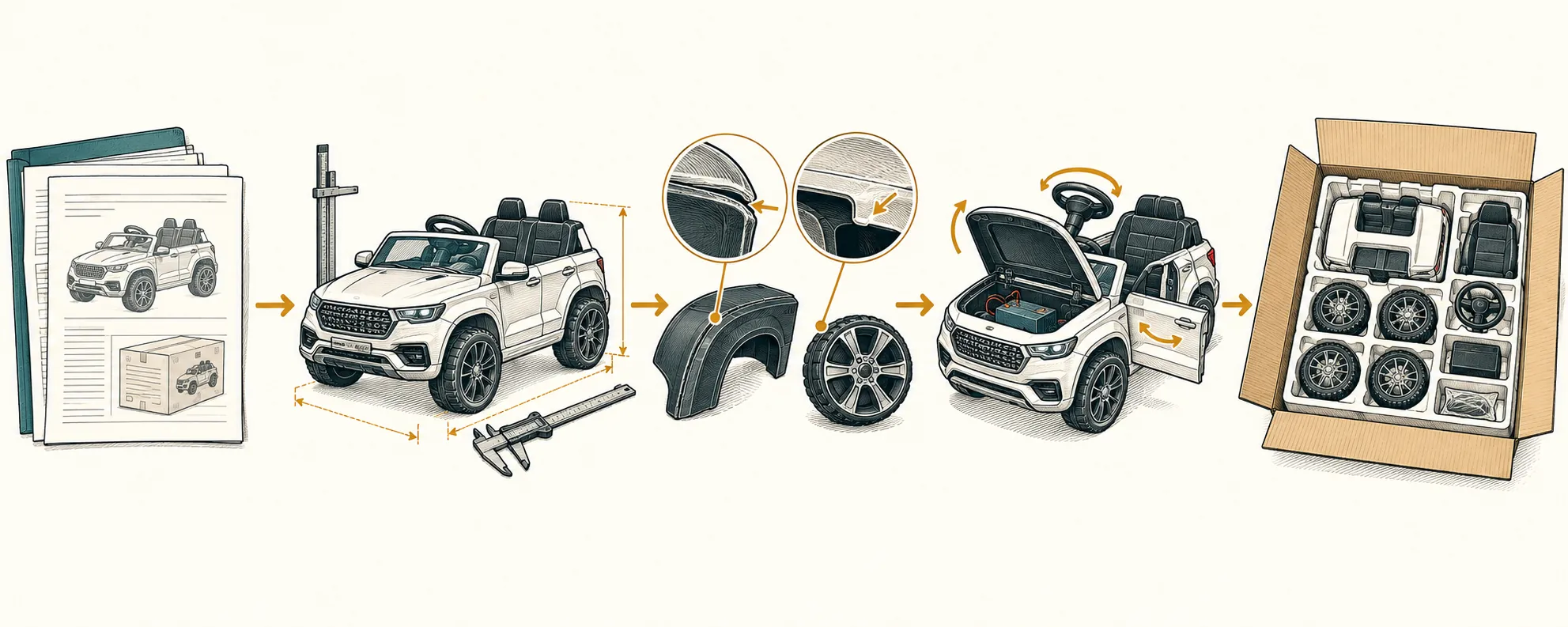
Track electric ride-on car and SUV carton revisions by giving each approved packing specification a revision ID, then comparing closed production cartons against that exact version before release. For private label electric ride on toys, keep proposed quote data separate from approved specifications and final packed measurements. Record dimensions, carton count, weights, strength evidence, and shipping marks; approve acceptable differences, hold affected cartons for unresolved discrepancies, and close corrective actions with a named approver and date.
What exactly is being approved, by whom, and how is the revision identified?
Approve a defined carton specification for a specific item and packing configuration, with a named buyer-side authority and an effective production point.
Keep three records distinct: proposed pre-PO packing data for planning, the signed carton specification authorizing production, and final packed measurements supporting the shipment packing list. A quotation or catalog entry is a reference, not a carton approval.
Give the carton specification and artwork separate revision identifiers if they can change independently. Link both to the buyer item number, supplier item reference, vehicle configuration, PO, and applicable production lot. Include external closed-carton dimensions and units, units per carton, gross and net weight definitions, board construction and strength criteria, closure method, and approved shipping-mark artwork.
Record what changed, why it changed, the previous revision, the new revision, approval date, approver, and the first lot or carton-number range using the change. Define whether old cartons may be consumed, relabeled, segregated, or replaced. Do not leave that decision to the packing line.
Agree measurement tolerances and discrepancy authority before inspection. An acceptable dimensional variation can be recorded without creating a new revision; an intentional specification change needs approval. A revision log supports traceability, but it cannot by itself reveal an undisclosed material substitution.
Which catalog references must stay separate?
| Electric Ride-On Car — ROW-353518 | Packing: carton; 1 unit per carton; recorded gross weight: 14.8 kg; recorded net weight: 12.6 kg. |
|---|---|
| Electric Ride-On Car — ROW-353517 | Packing: carton; 1 unit per carton; recorded gross weight: 16.9 kg; recorded net weight: 14.9 kg. |
| Electric Off-Road SUV Ride-On — ROW-353539 | Packing: carton; 1 unit per carton; recorded gross weight: 15.7 kg; recorded net weight: 13.3 kg. |
How do you inspect closed cartons against the approved revision?
Inspect identified, fully packed and sealed cartons against the approved specification, recording the target, observation, discrepancy, and next decision for each check.
Agree the inspection selection and acceptance criteria with the buyer. Include each active carton revision and packing configuration, and identify the lot and carton numbers checked. Photograph the closed carton, revision marking, shipping marks, measurement setup, and any damage. Record the observer, date, measuring equipment, and scale identity so another reviewer can follow the comparison.
| External dimensions and CBM | Record: approved dimensioned drawing and measurement tolerance. Inspect: external L × W × H of the closed carton in the stated units, including bulges or protrusions; do not compress the carton to obtain a smaller reading. Discrepancy: a measurement outside the agreed tolerance or a changed carton shape. Next decision: remeasure, identify the affected revision or lot, and obtain correction or approval before updating volume records. |
|---|---|
| Carton count and units per carton | Record: approved pack configuration, packing-line records, carton-number ranges, and draft packing list. Inspect: physical carton count, configuration labels, and duplicate or missing carton numbers. Discrepancy: counts or unit totals that do not reconcile. Next decision: recount and resolve the affected records. A sealed-carton label alone does not prove the contents count; retain the linked pack-out evidence. |
| Gross and net weights | Record: approved weight basis, agreed tolerance, and packing records. Inspect: weigh the closed carton for gross weight and compare the documented net weight on the same defined basis. Discrepancy: an unexplained weight difference or totals calculated from another configuration. Next decision: check the scale, packing record, and item identity before accepting or investigating further. Do not infer net weight from a closed-carton weighing alone. |
| Strength evidence and carton condition | Record: approved board construction, strength criteria, closure specification, and linked packaging test results. Inspect: visible crushing, moisture damage, split seams, damaged corners, and tape or strap differences. Discrepancy: damaged cartons, changed construction, or results outside agreed criteria. Next decision: segregate damage, confirm the packaging specification, and require the agreed packaging test where strength needs verification. A hand squeeze is not a strength test. |
| Shipping marks and artwork | Record: approved artwork revision and order-specific marking instructions. Inspect: item and configuration identity, PO reference, carton numbering, quantity, weight and dimension statements where specified, handling marks, and barcode readability. Discrepancy: obsolete artwork, conflicting identifiers, illegible printing, or overlapping old and new labels. Next decision: correct or relabel under approval, then verify the finished marks again. |
What should the carton revision log contain?
Use one controlled record per affected item, packing configuration, and revision, with observations linked to a clear disposition and closure.
The identity fields should include the buyer and supplier item references, configuration, PO, lot, inspected carton numbers, approved specification revision, artwork revision, and approval date and approver. Attach the approved drawing and artwork rather than relying on filenames in an email thread.
For each check, place the specified target and buyer-agreed tolerance beside the observed result. Add the observation date, observer, photographs or report references, match/discrepancy status, and affected carton range. Keep the original observation when a carton is reworked; append the reinspection result instead of overwriting it.
Finish the record with the decision, conditions, corrective-action owner, due date, reinspection evidence, closure verifier and date, and shipment-release approver and date. If two revisions ship together by approval, list their quantities and carton-number ranges separately so the packing list can be reconciled.
Hypothetical SUV carton revision record
This hypothetical record shows how an importer can hold a dimensional discrepancy, calculate its volume effect, and document closure without treating the observation as a new approval.
Identity and baseline: buyer item SUV-A, PO DEMO-01, packing lot DEMO-L1, carton specification R02, and artwork A03. The buyer packaging lead approved both references on October 12, 2026. For this example only, the approved external dimensions are 120 × 60 × 40 cm, with a buyer-defined tolerance of ±1 cm on each dimension. These are illustrative purchasing criteria, not an industry or legal standard.
Observation: on October 20, 2026, the inspector records carton 01 as 120 × 62 × 40 cm. Its width exceeds the agreed tolerance. The record identifies the affected lot for segregation and further inspection rather than assuming that every carton has the same discrepancy. Gross weight, documented net weight, pack-out records, shipping marks, and linked strength evidence are recorded as matching their approved references.
CBM calculation: L(cm) × W(cm) × H(cm) / 1,000,000. The approved carton is 120 × 60 × 40 / 1,000,000 = 0.288 CBM. If all 50 cartons measured the observed larger size, the total would be 0.2976 × 50 = 14.88 CBM, compared with 0.288 × 50 = 14.40 CBM at the approved dimensions—a difference of 0.48 CBM. This is a hypothetical volume comparison, not a measurement of a catalog product.
Decision and closure: the buyer packaging lead records a hold on the affected lot on October 20 and assigns the supplier packing supervisor to restore specification R02. Following correction and the agreed reinspection, the inspector records dimensions within the approved limits on October 21 and attaches the results. The packaging lead verifies closure and authorizes release that day. The final packing list uses the verified packed measurements and carton count, not the earlier hypothetical larger-carton total.
When should you approve, hold, or require rework?
Approve cartons that meet the controlled specification, hold affected cartons when a consequential discrepancy remains unresolved, and require rework or a documented revision approval when the intended packing has changed.
A reading within the agreed tolerance can be accepted with the measurement retained. For a deliberate change, assess the new dimensions, volume, weights, strength evidence, and marking consequences before approving a new revision. If accepting a deviation for one lot only, state its scope and conditions; do not silently rewrite the permanent specification.
Before carton release, reconcile the approved revision, inspection record, physical carton count, carton-number ranges, and final packing list. Calculate total CBM separately for each verified carton size, then add the groups. Reconcile gross and net weight totals on their defined bases. Any palletized shipment dimensions should be recorded separately from carton-only CBM.
Release only when discrepancies are closed or have an authorized disposition whose release conditions are satisfied. Record the responsible approver and date. Carton approval is one release gate; it does not replace separate product-safety approval or destination-specific document checks.