
supplier / BUYER DESK
Fire Truck Ride-On: Hold for Missing Carton Height?
Published 2026-11-03 · Updated 2026-11-03
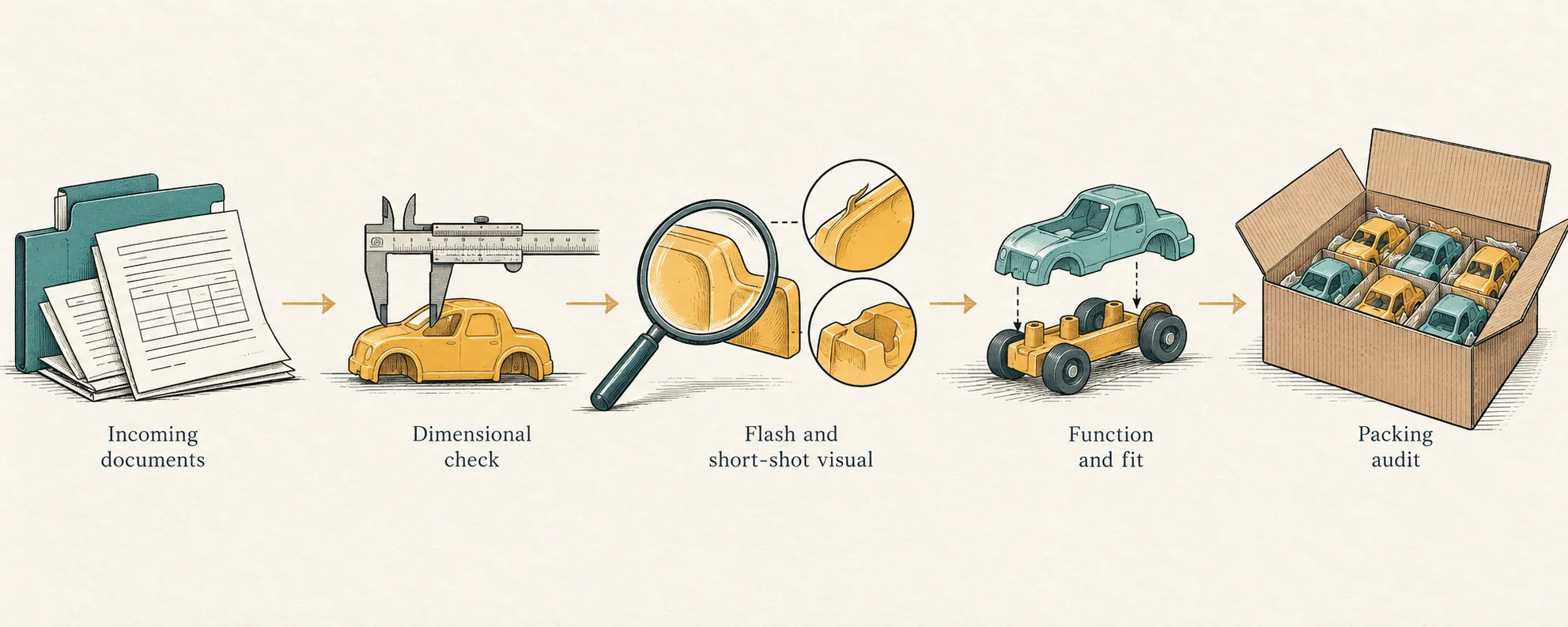
Pause order approval when missing carton height prevents the buyer from accepting the proposed packing plan, but do not treat the omission as proof of a defective product. In this hypothetical fire truck ride-on case, the buyer requests a revised packing specification, records exactly which approval is on hold, and sets a written release condition. Proposed pre-PO dimensions support the purchasing decision; final closed-carton measurements and packing-list reconciliation remain separate checks before shipment.
What should the buyer record on the hold/release worksheet?
| Product and SKU identity | Electric Fire Truck Ride-On; SKU: ROW-353536; product type: Kids Fire Truck. |
|---|---|
| Quoted configuration | Configuration and factory-folder reference: DLS-X9; voltage: 12V; battery: 12V7AH × 1; motor designation: 550 × 2. Record these as supplier-stated specifications, not buyer-verified construction. |
| Market variant and intended destination | Quoted variant: Southeast Asia. Enter the intended destination separately; the variant name does not establish suitability for another market. |
| Order, documents, and revisions | Enter the inquiry or draft-order reference. Hypothetical reviewed versions: quotation Q0 and proposed packing sheet P0. Record each document's actual revision and date, then link its replacement. |
| Sample and packing reference | Enter the sample ID and packing revision being compared. State whether it is a product sample, a packed sample, or production packing; do not transfer dimensions between them without confirming the pack configuration. |
| Specified target | Buyer requires proposed closed-carton external L × W × H with explicit units, units per carton, proposed weights, carton construction or agreed strength specification, and shipping-mark artwork before order approval. |
| Supplier-stated versus buyer-observed status | Supplier-stated: product configuration and any populated proposed packing fields. Buyer-observed in this hypothetical review: external height and its unit are absent from Q0/P0. No physical carton measurement has been made. |
| Issue and current decision | Missing field: proposed external carton height and unit. Decision: HOLD order approval. This is a packing-data clarification, not a finding of physical damage or a product-safety failure. |
| Release condition | Supplier issues a revised packing sheet with complete external dimensions and units, identifies the exact pack configuration, and recalculates proposed CBM. Buyer accepts the revised proposal against the purchasing requirements. |
| Action owner and due date | Enter the named supplier packing contact, the buyer purchasing owner, the clarification due date, and the scheduled decision-review date. |
| Approver and decision date | Enter the responsible buyer approver's name, actual decision date, approved document revisions, and the scope of release. Record any conditions that remain open. |
| Follow-up and closure | Record the replacement document, review result, closure date, and closing approver. Carry final packed measurements and packing-list reconciliation into a separate pre-shipment checkpoint. |
What should be inspected on the closed shipping carton?
| External dimensions and units | Inspect: measure external L × W × H on the closed carton, including protrusions or bulging that affect its shipping envelope, and record cm or mm explicitly. Compare: approved packing drawing and final measurement record. Discrepancy: omitted unit, product dimensions used as carton dimensions, or measurements outside the agreed tolerance. Next decision: clarify, remeasure, or approve the documented variation before updating CBM. |
|---|---|
| CBM and carton grouping | Inspect: calculate volume from external dimensions and group cartons by actual pack size. Compare: dimension record, carton count, and packing-list volume. Discrepancy: inconsistent units, arithmetic error, or one size applied to different carton configurations. Next decision: correct the calculation and review the revised shipment volume. |
| Carton count and units per carton | Inspect: count closed cartons and reconcile their identifiers. Compare: order quantity, approved units-per-carton specification, packing logs, and final packing list. Discrepancy: missing or duplicate carton numbers, or a total that does not reconcile. Next decision: recount and correct the records; if content quantities remain disputed, arrange a separate content verification. A printed quantity alone does not verify what is inside. |
| Gross and net weights | Inspect: weigh closed cartons for gross weight using the agreed weighing method. Compare: approved proposed weights, final weighing record, and packing-list totals. Discrepancy: unexplained variation beyond the agreed tolerance or gross and net values interchanged. Next decision: reweigh and investigate the packing configuration. Net weight needs its own supporting record; a closed-carton weighing does not establish it. |
| Carton strength and condition | Inspect: check for crushing, wet damage, split seams, failed closures, and deformation. Compare: approved carton construction, agreed strength specification, and any packaging-performance evidence requested by the buyer. Discrepancy: visible damage, changed construction, or performance outside the agreed acceptance criteria. Next decision: segregate affected cartons, obtain packaging review, or repack and reinspect. Appearance alone does not establish compression strength. |
| Shipping marks and labels | Inspect: check legibility, carton numbering, product or variant identification, quantity, and any agreed printed weights or dimensions. Compare: approved artwork, order reference, and final packing list. Discrepancy: wrong revision, duplicate number, illegible mark, or conflicting information. Next decision: correct or relabel, then reconcile the affected records before closing the issue. |
How should the buyer calculate CBM after receiving the missing height?
Calculate carton CBM from external dimensions in centimeters, then multiply by the number of cartons with that same packing configuration.
Explicitly hypothetical calculation: L(cm) × W(cm) × H(cm) / 1,000,000. A closed carton measuring 120 × 70 × 60 cm has a volume of 0.504 m³. For 40 identical cartons, total carton volume is 0.504 × 40 = 20.16 m³. These are invented calculation inputs, not packing specifications for the fire truck ride-on.
If those dimensions are proposed before packing, label the result proposed CBM. Recalculate using final packed measurements before shipment. Calculate different carton sizes separately and add their totals; do not borrow dimensions from another ride-on model or assume that carton volume equals a complete transport-space requirement.
What written clarification should the buyer send?
Request a revised, configuration-specific packing sheet that supplies the missing field and distinguishes proposed figures from measured packed results.
Suggested request: “Please revise the packing sheet linked to this quotation to include external closed-carton L × W × H and measurement units. Confirm the pack configuration, units per carton, proposed gross and net weights, carton construction or agreed strength specification, and shipping-mark revision. Mark these figures as proposed or measured. Identify the documents being replaced and return the revised sheet by the due date recorded in the hold worksheet.”
When packed cartons are available, request a measurement record tied to carton identifiers, showing the readings and units. Photos can support that record, but general QC images or videos do not by themselves certify conformity, functionality, or the absence of hidden defects. How to Buy from 1688
When should the buyer release, conditionally release, or keep the hold?
| Release the current approval | Choose release when the corrected packing revision supplies the required field and meets the buyer's acceptance criteria. Record the approver, decision date, accepted quotation and packing revisions, and closure evidence. State explicitly whether this releases order approval or shipment. |
|---|---|
| Conditionally release a defined activity | Choose conditional release when an acceptable proposed packing specification supports order approval, but final packed verification is still pending. Record the authorized activity, remaining shipment hold, action owner, deadline, approver, and decision date. Close the remaining condition only after measured packing records and the final packing list have been accepted. |
| Continue the hold | Keep the relevant approval on hold when height or units remain unresolved, records describe different pack configurations, or a discrepancy exceeds the agreed acceptance criteria without an approved disposition. Record the reason, required correction, responsible owner, reviewing approver, decision date, and next review date. |
What does closing the carton hold actually approve?
Closing the carton hold approves only the packing issue and release scope recorded by the buyer—not product safety, destination paperwork, or every other order condition.
Keep product-safety testing and destination-specific document review as separate release checks. The Southeast Asia quotation variant is an identity reference, not approval for US, EU, or other destinations.
A completed worksheet creates traceability between the issue, correction, and decision. It does not by itself reveal an undisclosed packing change; revision control and checks against the actual packed shipment still matter.