
review / BUYER DESK
Ride On Pickup Truck Wholesale: Dump Beds & Wheel Bands
Published 2026-11-27 · Updated 2026-11-27
A 3-year-old loads six pinecones into the bed of a 12 V ride-on pickup, drives 8 m across a lawn, stops at the sandbox and pulls the tailgate latch. That single sequence is the product: a drive becomes a haul-and-unload yard task, and the bed floor, hinge pivots, latch spring and wheel bands take loads the original car platform never saw. For ride on pickup truck wholesale buyers, the sourcing decision therefore starts at the rear 2 components — dump bed and tailgate latch — not at the sticker kit.
This catalog-level review covers what a buyer can verify per SKU before quoting: hinge and pivot hardware, latch engagement, bed-wall thickness, EVA-band versus molded PP wheels for 4 surface types (lawn, gravel, packed dirt, pavement), and the US documentation chain from ASTM F963 through the Children's Product Certificate. The supplied sources contain no ride-on pickup SKU, no dump-bed or wheel data and no payload figures, so every dimension below is framed as a question to resolve at model level, and the one worked calculation is explicitly illustrative.
Use it as a screening sheet: 6 evidence fields, 6 comparison rows and 3 compliance documents that separate a quotable ride-on pickup from a photo of one. The yard-play case also has a developmental angle: WHO reports that in children and adolescents physical activity improves motor and cognitive development, and 86% of adolescents globally do not meet recommended activity levels.
Dump-Bed Hardware: What to Verify Before the Bed Becomes a Load Path
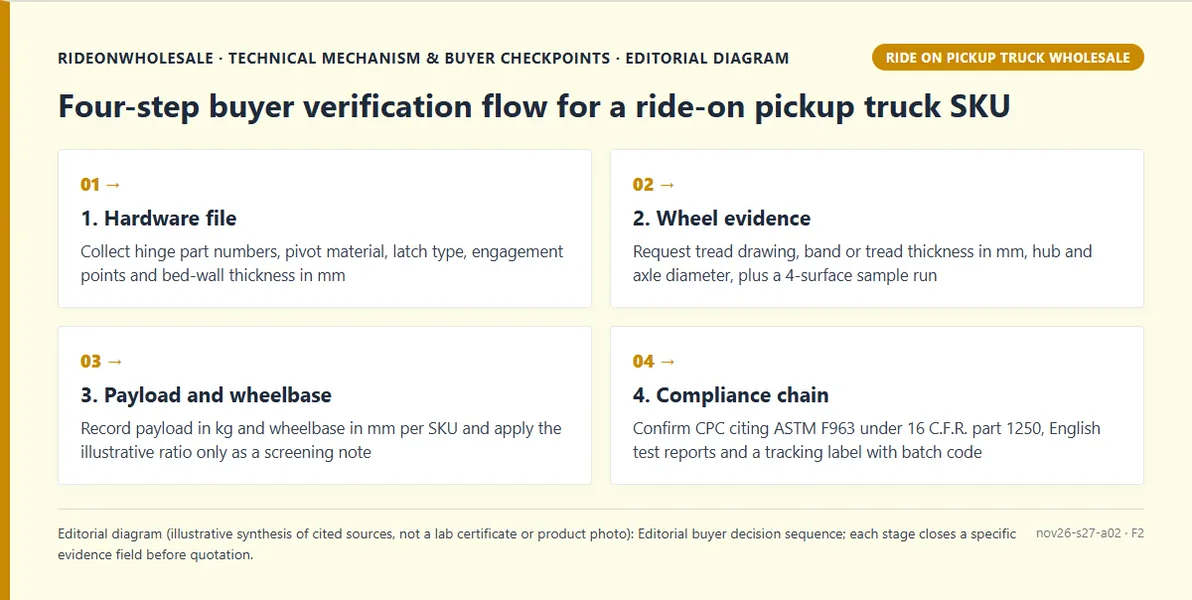
A rear dump bed adds at least 4 hardware groups to a ride-on pickup: the hinge pair at the front of the bed, the pivot pins or bushings inside those hinges, the tailgate latch (single or dual), and the bed-wall and floor panels that carry the load between them. Ask for a hardware list per SKU with part numbers, material callouts and a photo of each group removed from the body. A bed that tips on 2 hinges with no bushing wears metal-on-plastic at the pivot, and a latch with 1 engagement point concentrates the tailgate load on a single tab.
Latch engagement is the field most often left blank. Request the latch type (spring-loaded slide, over-center draw latch, rotating cam), the number of engagement points, and the measured latch travel in mm. On a 2-piece tailgate, confirm whether the latch releases from 1 side or 2, because a 1-side release on a 600 mm-wide gate twists the panel every cycle.
Bed-wall thickness belongs in the same request. Ask for panel thickness in mm for floor, side walls and tailgate, plus the rib or channel pattern that stiffens the floor. A flat 2 mm PP floor and a ribbed 2 mm PP floor carry different loads, and the rib pattern is the evidence that distinguishes them.
Hardware changes are not cosmetic. CPSC defines a material change as a change to a children's product's design, manufacturing process or source of component parts that could affect compliance, and it requires third-party testing by a CPSC-accepted laboratory plus a new CPC. A new latch supplier or a switch from metal to molded PP hinges falls inside that definition until the importer documents otherwise, and a component-only change may allow a new CPC built on the earlier test plus the new component test. A change of manufacturing facility requires retesting the entire product.
EVA-Band vs Molded PP Wheels: Four Surface Types, One Evidence Request
Wheel construction decides whether the pickup rolls across a lawn or digs into gravel, and the two common build types behave differently for reasons a buyer can inspect. An EVA-band wheel wraps an EVA tread band around a separate hub or rim; a molded PP wheel is a single injection-molded part with the tread formed into the same plastic as the hub. The first has a bond line between band and rim; the second has no bond line but a stiffer tread.
For each wheel type, request 5 fields: tread pattern (photo plus drawing), band or tread thickness in mm, hub construction (number of spokes, bearing type, axle diameter in mm), stated surface suitability, and any surface-specific test evidence the factory holds. The supplied sources contain no EVA or PP performance data, so treat any claim of better grip on gravel or lower vibration on pavement as unverified until the test report or a sample run on the 4 named surfaces backs it.
Run the sample on the same 4 surfaces the end customer uses: lawn, gravel, packed dirt and pavement. Record push effort, visible band wear and hub play after the run. A wheel that sheds its EVA band at the bond line on gravel and a molded PP wheel that transmits every stone into the axle are different failure modes, and the sample run is the cheapest way to see which one the SKU has.
Wheel material sits inside the material-change rule as well. A band change from EVA to molded PP, or a new hub supplier, is a design or component-source change that the importer should document and test before the revised SKU ships. The AAP's parent guidance adds a retail-facing check: sturdy plastic over thin plastic that can break into sharp pieces, and a UL mark on electric toys.
Illustrative Payload-to-Wheelbase Screening: 30 kg Over 620 mm vs 700 mm
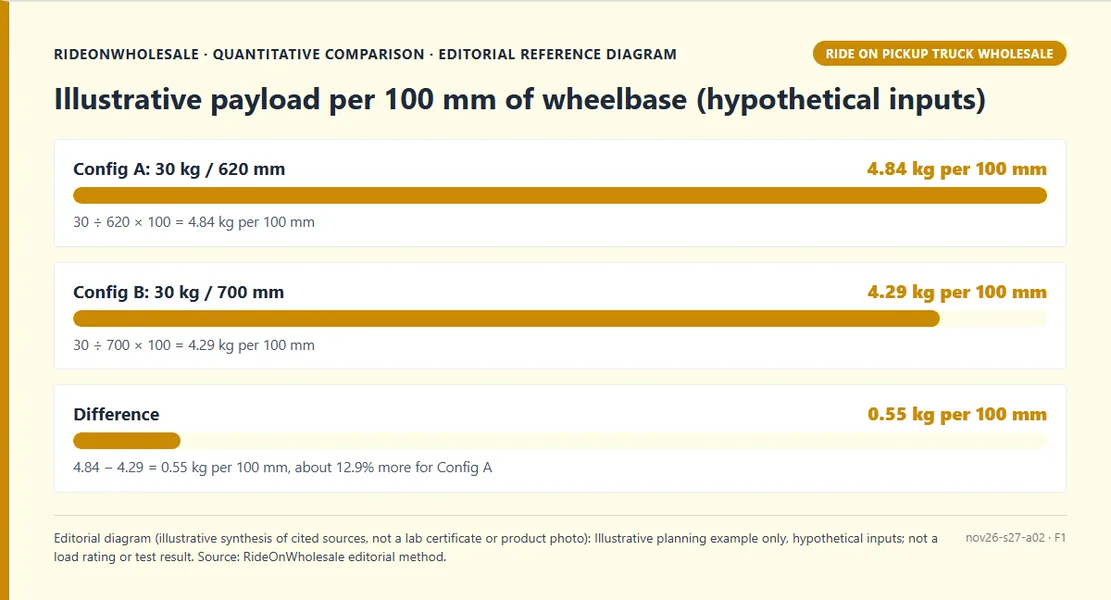
Payload and wheelbase are the 2 numbers that frame the haul-and-unload use case, and both remain quotation- or document-dependent until the model file states them. The following is an illustrative planning example with hypothetical inputs, not a load rating, a test result or a product claim. Configuration A carries an illustrative payload of 30 kg on a 620 mm wheelbase; Configuration B carries the same 30 kg on a 700 mm wheelbase.
Formula: payload per wheelbase unit in kg per 100 mm = payload (kg) ÷ wheelbase (mm) × 100. Configuration A: 30 ÷ 620 × 100 = 4.84 kg per 100 mm. Configuration B: 30 ÷ 700 × 100 = 4.29 kg per 100 mm. Difference: 4.84 − 4.29 = 0.55 kg per 100 mm, so Configuration A carries about 12.9% more illustrative payload per 100 mm of wheelbase than Configuration B (0.55 ÷ 4.29 × 100 = 12.82%, rounded to 12.9%).
The reader takeaway is a question, not a verdict: a longer wheelbase spreads the same illustrative payload over more length, so request both payload and wheelbase per SKU, in kg and mm, and use the ratio only to rank candidates before documentation arrives. The same discipline applies to speed and range, which the catalog treats as quotation-dependent attributes rather than published specs.
Six-Field Evidence Matrix for a Ride-On Pickup Truck SKU
The table below converts the article into a per-SKU request sheet. Each row names the field, the document or physical check that closes it, and what stays quotation- or document-dependent after the check.
Columns: Field | What to request | Evidence format | Still quotation/document dependent.
| Field | Evidence format | What to request | Still quotation/document dependent |
|---|---|---|---|
| Dump-bed hinge and pivot | Exploded drawing plus photo of hinge removed from body | Hinge part numbers, pin or bushing material, pivot travel in mm | Cycle-life figure and load rating |
| Tailgate latch | Latch datasheet plus 10-cycle open/close video | Latch type, engagement points, latch travel in mm, 1- or 2-side release | Retention force under load |
| EVA-band wheel | Wheel drawing plus 4-surface sample run notes | Tread drawing, band thickness in mm, hub spokes, axle diameter in mm, bond-line photo | Wear life and grip ranking |
| Molded PP wheel | Molded-part drawing plus 4-surface sample run notes | Tread drawing, tread thickness in mm, hub and bearing type, axle diameter in mm | Wear life and vibration data |
| Payload and wheelbase | Model specification sheet | Payload in kg and wheelbase in mm per SKU, with the model file reference | Verified load rating and speed |
| US compliance documents | CPC PDF, test report PDFs, label photo with batch code | CPC citing each applicable children's product safety rule, English test reports from a CPSC-accepted laboratory, tracking label sample | Which ASTM F963 version applies and eFiling data set |
The US Document Chain: ASTM F963, the CPC and the Tracking Label
For a US-bound ride-on pickup, 3 documents anchor the file. First, ASTM F963 is mandatory for children's toys under CPSIA section 106, codified at 16 C.F.R. part 1250, and 16 C.F.R. § 1250.2 identifies the latest Commission-accepted version. ASTM F963 covers products for children under 14 years, while CPSC testing and certification apply to products designed or intended primarily for children 12 years or younger, so the age positioning on the box and listing must match the certification path.
Second, the Children's Product Certificate. Section 14 of the CPSA, codified at 16 CFR part 1110, requires domestic manufacturers and importers of children's products to certify in a written CPC, based on test results from a third-party CPSC-accepted laboratory, that the product complies with applicable children's product safety rules, and the CPC and supporting test reports must be in English. The importer carries that obligation, so a wholesale buyer budgets for third-party testing before the first shipment, and from July 8, 2026 importers of most regulated consumer products must electronically file certificates of compliance with U.S. Customs and Border Protection via a Partner Government Agency Message Set.
Third, the tracking label. CPSA section 15(a)(5)(A) requires marks that are visible and legible, permanently affixed to the product and packaging to the extent practicable, and that disclose manufacturer/importer or private labeler name, location and date of production, batch or run number and other source-identifying information. The tracking label is not a safety rule requiring certification under section 14(a)(1), so the CPC does not reference it, but a sample label with a readable batch code belongs in the SKU file because it is the recall-response link between the bed, the latch and the wheel batch.
For EU-bound volume, the parallel file is different. The Toy Safety Directive 2009/48/EC sets the essential safety requirements for toys marketed in the EU, and Regulation (EU) 2025/2509 enters into force on 1 January 2026 and applies from 1 August 2030, adding a digital product passport requirement for all toys. A dual-market pickup therefore needs 2 document sets, not 1 translated set.
Battery and Charger Evidence: Treat the Pack as Part of the Vehicle
CPSC staff has received consumer complaints and manufacturer and retailer reports involving battery and battery charger hazards, with potential hazards including overheating, fire, electrical shock from battery chargers, thermal burns, exposure to alkaline battery electrolytes and high-velocity ejected internal components. There have been a number of recalls involving other types of batteries used in products such as battery-powered ride-on toys and portable battery-powered tools, so the pack and charger belong in the quote-stage evidence file, not in the after-sales folder.
CPSC staff recommends that batteries be properly tested with the product, in its intended use and with the charger as a system, and that battery-powered products be designed with a system approach addressing thermal protection and charge and discharge protection. CPSC staff also participates in voluntary battery standard activities, including UL 2272 for electrical systems of personal e-mobility devices, UL 4200A for products incorporating button or coin cell batteries, and ASTM F963 for toy safety. Request the battery chemistry, pack construction, charger model and the system-level test report that names both the vehicle and the charger.
Battery sourcing is a component-source change when it moves. A new cell supplier or a new charger model is a change the importer documents and tests before the revised SKU ships, alongside any bed or wheel change.
Does a rear dump bed change how a ride-on pickup truck should be sourced?
Yes. A rear dump bed adds hinges, pivots and a tailgate latch that a buyer verifies per SKU, and a change to that hardware or its material can count as a material change requiring third-party testing and a new CPC under CPSC guidance. Request the hinge part numbers, latch type and bed-wall thickness in mm before quoting.
Are EVA-band wheels better than molded PP wheels for yard play?
Neither material is superior on the supplied evidence. The sources contain no EVA or PP wheel performance data, so request the tread drawing, band or tread thickness in mm, hub construction and a 4-surface sample run on lawn, gravel, packed dirt and pavement, then compare wear and hub play.
What documents should accompany a US-bound ride-on pickup truck?
Three documents anchor the file: a Children's Product Certificate issued by the importer based on third-party CPSC-accepted laboratory testing, supporting test reports in English, and a tracking label with manufacturer or importer name, production location and date, batch information and source-identifying details. ASTM F963 is the mandatory toy safety standard cited through 16 C.F.R. part 1250, and from July 8, 2026 most regulated consumer products require electronic certificate filing with U.S. Customs and Border Protection.
Build the Six-Field File for Your Next Ride-On Pickup
Start with the Construction & Specialty Rides collection on RideOnWholesale, shortlist 2 or 3 pickup platforms, and open a per-SKU request using the 6 fields in the matrix above: hinge and pivot, tailgate latch, EVA-band wheel, molded PP wheel, payload and wheelbase, and US compliance documents. Attach the illustrative 30 kg / 620 mm vs 700 mm ratio as a screening note, label it clearly as hypothetical, and hold price, MOQ, battery, speed, load, age, certification and delivery as quotation- or document-dependent until the model file and test reports arrive.
Sources
www.cpsc.gov — Batteries | CPSC.gov
www.cpsc.gov — Toy Safety Business Guidance | CPSC.gov
www.cpsc.gov — Children's Product Certificate | CPSC.gov
www.cpsc.gov — Tracking Label Business Guidance | CPSC.gov