
sourcing / BUYER DESK
Ride On Toys Bulk Order Planning for 2027: Spares & Labels
Published 2026-11-26 · Updated 2026-11-26
Picture an aftersales queue on the Monday after a weekend promotion: several chargers that run hot within 20 minutes, foot-switch pedals that never close the circuit, battery harnesses with a loose inline connector and one carton short a charger entirely. Each ticket becomes a refund decision, and the traceability question is the same every time: which production run built this unit?
That queue is the real specification document for a 2027 ride on toys bulk order. A mixed container of push cars, 12V cruisers and matched spare-part kits is not three product lines stacked together; it is one traceability system where the charger, switch and harness must be matched to the vehicle platform, labeled to the same batch code and covered by a change-notification clause before the purchase order is signed.
This planning guide works through the kit ratio arithmetic, the exact CPSC tracking-label fields, the material-change retest trigger and the post-July 2026 certificate eFiling timeline, using the RideOnWholesale catalog structure (Electric Cars & SUVs; Electric Motorcycles & ATVs; Drift, Go-Kart & Racing Rides; Construction & Specialty Rides) as the platform frame. Model-level price, MOQ, battery, speed, load, age, certification, licensing and delivery stay quotation- or document-dependent.
Why chargers, switches and harnesses belong inside the bulk order, not in an accessory bin
CPSC staff has logged consumer complaints and manufacturer and retailer reports of battery and charger hazards that include overheating, fire, electrical shock from battery chargers, thermal burns and high-velocity ejected internal components, with incidents occurring in use, in storage and during charging. CPSC also records recalls involving batteries used in battery-powered ride-on toys. The charging and storage window is therefore a documented hazard window, and a matched, traceable spare is a return-and-recall control rather than a convenience SKU.
CPSC staff recommends that batteries be properly tested with the product, in its intended use and with the charger as a system. That system framing is the reason a 12V cruiser lot cannot ship with an unmatching charger pulled from a generic bin: the charger is part of the tested configuration, and a swapped charger is a different system.
The three-line structure follows directly. Push cars carry mechanical and fit failures (pedals, steering linkages, wheel retainers). 12V cruisers carry electrical failures (charger, foot switch, battery harness connector). Spare-part kits carry the recovery path for both. Each kit line maps to one named failure point, so the kit is a service part with a part number, not a mixed bag.
Sizing the 2–3% spare-part kit allowance: a worked planning example
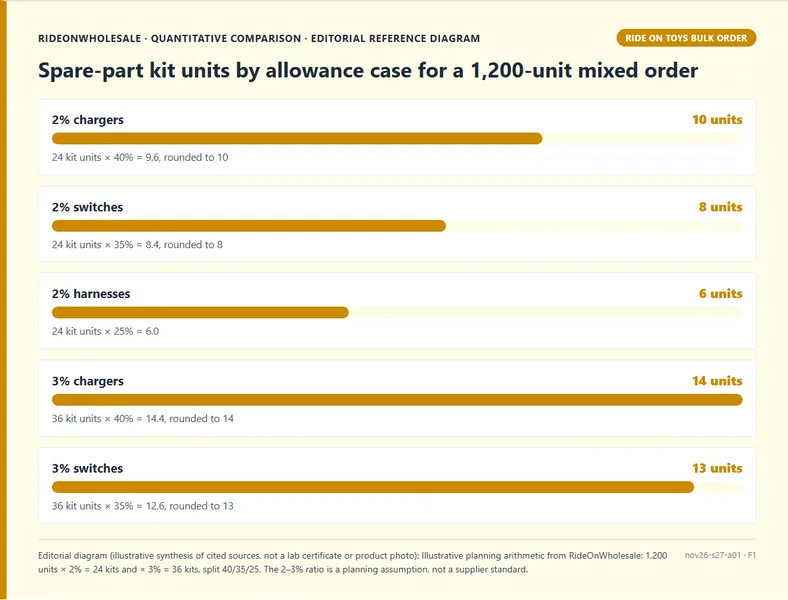
Treat the 2–3% ratio as a planning assumption, not a supplier standard. For a 1,200-unit mixed order, the 2% case is 1,200 × 0.02 = 24 kit units; the 3% case is 1,200 × 0.03 = 36 kit units. Split the kit at 40% chargers, 35% switches and 25% battery harnesses. The 2% case yields 24 × 0.40 = 9.6 chargers (round to 10), 24 × 0.35 = 8.4 switches (round to 8) and 24 × 0.25 = 6.0 harnesses (6). The 3% case yields 36 × 0.40 = 14.4 chargers (round to 14), 36 × 0.35 = 12.6 switches (round to 13) and 36 × 0.25 = 9.0 harnesses (9).
Allocate by lot, not by container. If the 1,200 units split 700 push cars and 500 12V cruisers, the 2% case gives 700 × 0.02 = 14 kits to the push-car lot and 500 × 0.02 = 10 kits to the 12V cruiser lot, totaling 24. Push-car kits skew toward switches and mechanical fit parts; cruiser kits skew toward chargers and harnesses. The 40/35/25 split is a starting point that the return-ticket history then corrects.
Correct it with counts, not impressions. Pull the last 12 months of tickets, tag each one charger, switch, harness or other, and divide by units sold per platform. A platform with 6 charger tickets per 500 units justifies a higher charger share than the 40% default; a platform with 1 harness ticket per 700 units justifies trimming harness share toward 15%. Recompute the kit split once per season and freeze it before the 2027 PO.
Push cars, 12V cruisers and spare-part kits compared across return risk and evidence
The table maps each line to its likely return-ticket driver, the matched spare part, the tracking-label fields to specify, the change-notification risk and the evidence to request before PO. Model-level values (battery chemistry, voltage configuration, load, age band, certification status) remain quotation- or document-dependent.
| Line | Matched spare part | Change-notification risk | Likely return-ticket driver | Evidence to request before PO | Tracking-label fields to specify |
|---|---|---|---|---|---|
| Push car lot | Foot switch and mechanical fit parts | Low for electrical; medium if switch source changes | Pedal, steering linkage, wheel retainer fit | Platform drawing, carton mark artwork, switch part number | Importer name, production location and date, batch or run number |
| 12V cruiser lot | Charger and battery harness | High: battery, charger or harness source change | Charger overheating, harness connector, foot switch | Battery/charger system test evidence plus separate CPC and test reports (English) | Same batch code on vehicle and carton, plant address code |
| Spare-part kit (2%) | 10 chargers, 8 switches, 6 harnesses per 1,200 units | Inherits the risk of the parent lot | Missing or failed part at unboxing | Kit bill of materials with part numbers per vehicle platform | Kit bag label carrying parent lot batch code |
| Spare-part kit (3%) | 14 chargers, 13 switches, 9 harnesses per 1,200 units | Inherits the risk of the parent lot | Higher-volume season or first-run platform | Same BOM plus ticket history supporting the higher ratio | Kit bag label plus carton-level lot code |
| Mixed container | Per-lot kit allocation (14 push car, 10 cruiser) | Any undeclared substitution resets certification | Lot isolation failure across cartons | Lot map linking carton IDs to batch codes | One batch code per lot, never per container |
Lot-level tracking labels: the exact fields to write into the PO
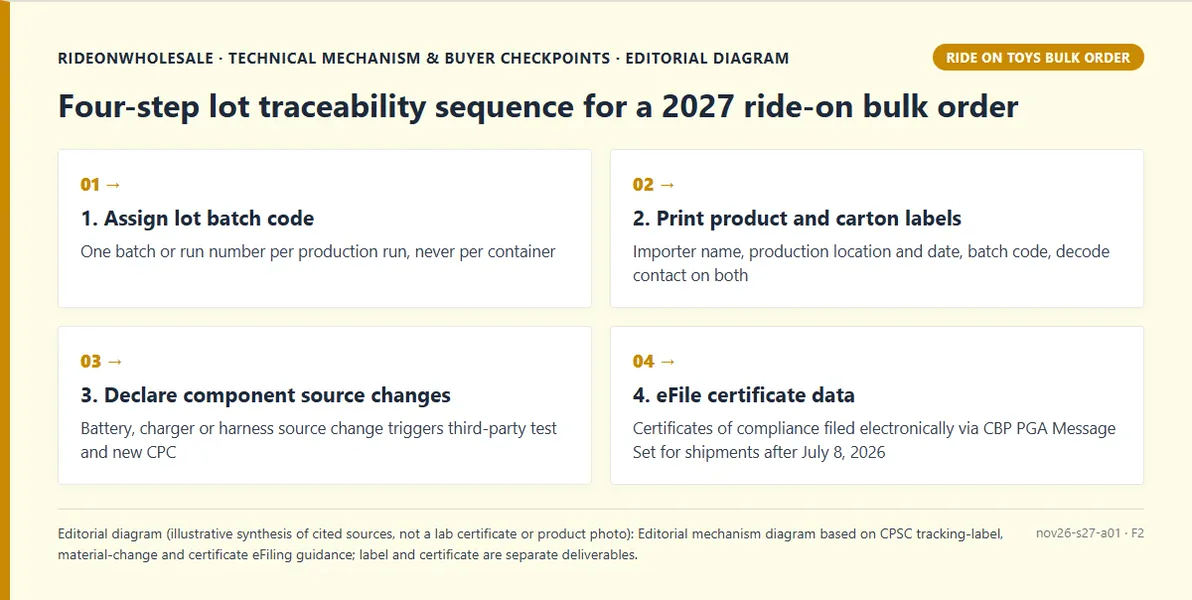
CPSA section 15(a)(5)(A), as amended by CPSIA section 103, requires children's products to bear visible, legible, permanently affixed distinguishing marks on the product and its packaging to the extent practicable. The marks must show the manufacturer, importer or private labeler name; the location and date of production; detailed manufacturing-process information such as a batch or run number; and any other information that facilitates ascertaining the specific source, such as the manufacturing plant address. Codes are permitted if the consumer knows who to contact to interpret them.
Write those four fields into the PO as separate line items, each with an acceptance check. Field 1: importer or private labeler name as registered. Field 2: production location and date in a fixed format (plant code plus YYYY-MM). Field 3: batch or run number unique per production run, not per container. Field 4: a contact route (URL or phone) that decodes the batch number. The carton label and the product label must carry the same batch code, or lot isolation fails on the first return ticket.
Plan the label volume. A 1,200-unit order packed 2 units per carton yields 1,200 ÷ 2 = 600 cartons, so 600 carton labels plus 1,200 product labels must each carry the same batch code. Approve the artwork at sample stage, then check 10 cartons per lot at receiving against the lot map before the container is released to the sales channel.
Change notification, retesting and the separate certificate deliverable
A battery, charger or harness source change is a material-change question, not a silent substitution. CPSC defines a material change as a change to design, manufacturing process or the source of component parts that could affect compliance; after a material change the firm must have samples of the product or component part tested by a third-party CPSC-accepted laboratory and issue a new CPC. Where the change affects only a component and does not affect the finished product's ability to comply with other applicable rules, a new CPC may rest on the earlier initial test plus the new component test.
Put a change-notification clause in the 2027 PO: any battery, charger, switch or harness source change must be declared in writing before shipment, with the new component test report attached. The clause converts an invisible substitution into a dated document the importer can file.
Keep the tracking label and the certificate as two separate deliverables. CPSC states the tracking label requirement is not a safety rule requiring certification under section 14(a)(1), and the CPC does not need to reference tracking labels. Children's products still need a CPC where other safety rules apply, based on third-party testing, with the CPC and supporting test reports in English. Section 106 of CPSIA made ASTM F963 mandatory for children's toys at 16 C.F.R. part 1250, and CPSC testing and certification apply to products intended primarily for children 12 years of age or younger.
Time the certificate logistics to the 2027 shipment date. Beginning July 8, 2026, importers of most regulated consumer products must electronically file certificates of compliance with U.S. Customs and Border Protection via a Partner Government Agency Message Set, so a 2027 container needs the certificate data ready for eFiling rather than a paper packet at the port.
Destination check: US label fields do not transfer to EU or Mexican requirements
The label fields above are US CPSC requirements. EU buyers work under the Toy Safety Directive 2009/48/EC, and Regulation (EU) 2025/2509 enters into force on 1 January 2026 and applies from 1 August 2030, adding a digital product passport for toys. A 2027 EU shipment therefore needs its own label and document set, not a copy of the US carton mark.
For consumer-facing electrical evidence, advises that electric toys should be UL approved and that the label be checked to confirm it. Treat that as one evidence item on the file, separate from the CPC, the tracking label and the component test report.
How many spare chargers, switches and harnesses should a 1,200-unit ride-on bulk order include?
A 1,200-unit order carries 24 kits at the 2% planning ratio or 36 kits at 3%, split into roughly 10–14 chargers, 8–13 switches and 6–9 harnesses. The 2% case computes to 10 chargers, 8 switches and 6 harnesses; the 3% case computes to 14 chargers, 13 switches and 9 harnesses. Allocate by lot: 700 push cars × 0.02 = 14 kits and 500 12V cruisers × 0.02 = 10 kits in the 2% case.
What must a lot-level tracking label on a ride-on toy and carton include?
A compliant tracking label carries four data points on both the product and its packaging: importer or private labeler name, production location and date, a batch or run number, and a contact route that decodes any code used. The label must be visible, legible and permanently affixed to the extent practicable. A 1,200-unit order packed 2 per carton needs 600 carton labels and 1,200 product labels sharing one batch code.
If the supplier changes the battery or charger source, does the ride-on need retesting?
A battery or charger source change is a material change when it could affect compliance, and it requires third-party testing by a CPSC-accepted laboratory plus a new CPC. Where the change touches only the component and leaves the finished product's compliance with other rules intact, the new CPC may combine the earlier initial test with the new component test. Write the declaration into the PO so the change surfaces before shipment, not after the container clears.
Build the 2027 order file platform by platform
Start with the four RideOnWholesale collections and shortlist one representative source SKU per platform, then attach the kit ratio, the four tracking-label fields, the change-notification clause and the certificate eFiling date to each line. Price, MOQ, battery, speed, load, age, certification, licensing and delivery stay quotation- or document-dependent, so the order file records the question rather than a placeholder number.
Open the catalog at RideOnWholesale and build the lot map before the first sample request goes out.
Sources
www.cpsc.gov — Batteries | CPSC.gov
www.cpsc.gov — Toy Safety Business Guidance | CPSC.gov
www.cpsc.gov — Children's Product Certificate | CPSC.gov
www.cpsc.gov — Tracking Label Business Guidance | CPSC.gov