
review / BUYER DESK
US/EU Electric Ride-On Wholesale: Choose by Material
Published 2026-11-11 · Updated 2026-11-11
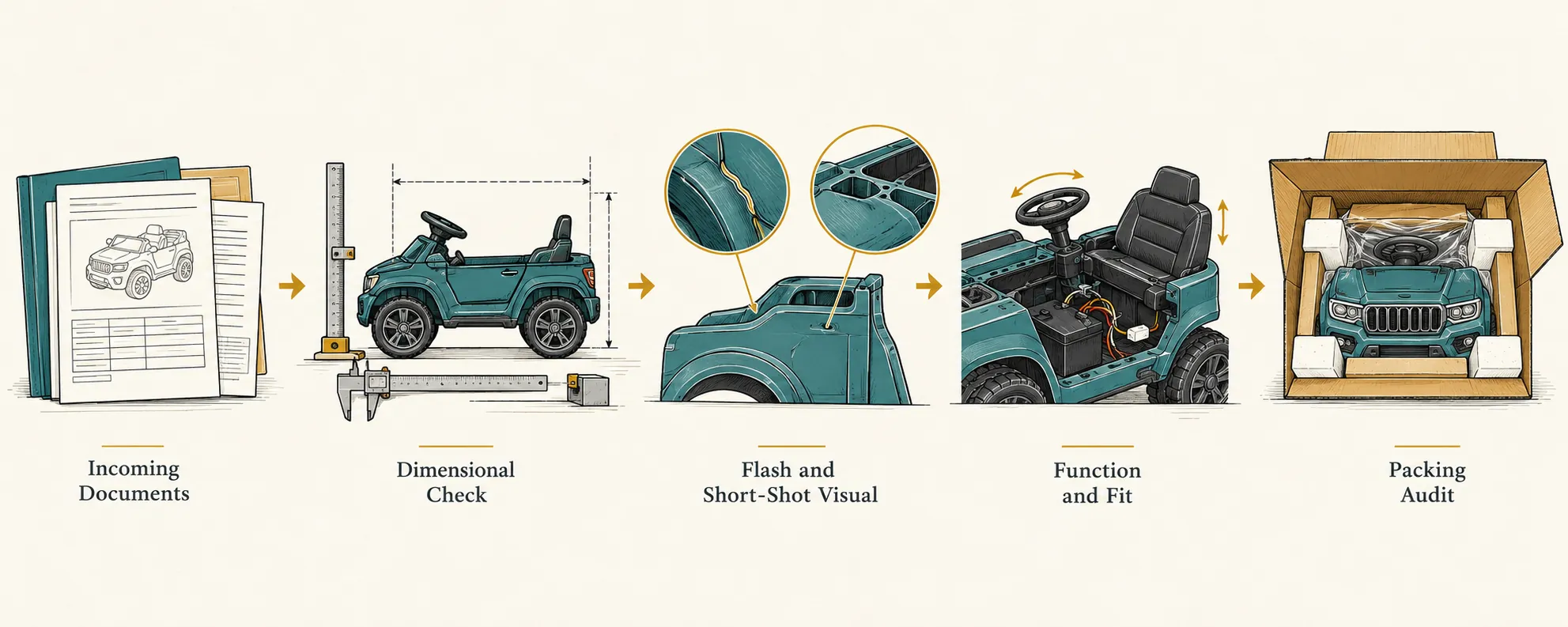
Choose an electric ride-on wholesale program by documented component materials and drive configuration, not its product photo. For US, EU, and global importers, an electric car and a drift ride-on fill different assortment roles, but their names do not establish chassis construction, wheel arrangement, battery, motors, or controls. The two catalog examples below support supplier inquiries, not purchase approval: keep both under consideration, then hold material-based selection until the proposed vehicle structure and configuration are documented.
Start with the platform’s job in the assortment. Use Electric Cars & SUVs for the general electric-car candidate and Drift, Go-Kart & Racing Rides for the drift candidate. Electric Motorcycles & ATVs and Construction & Specialty Rides are separate procurement collections. Battery, remote control, color, packaging, and licensing belong within each platform’s specification—not in duplicate product categories.
Which Electric Car and Drift Ride-On Candidates Should Advance?
| Electric Ride-On Car — source reference ROW-353516 | Assortment role: general electric-car candidate in Electric Cars & SUVs. C—product name: Electric Ride-On Car; packing: carton; units per carton: 1; source size entry: 113 × 56 × 35; gross weight: 14.8 kg; net weight: 12.6 kg; reference MOQ: 30 units; reference price: USD 74.6104. M—component materials, load-bearing structure, battery, motors, controls, assembled dimensions, and the units and meaning of the source size entry. Q—current specification, sample, price, MOQ, order-multiple restrictions if any, intended age and load evidence, destination documents, licensing if claimed, and delivery terms. Decision: HOLD material-based selection and PO approval; proceed with inquiry. Next supplier request: provide a revision-controlled material and construction schedule identifying the body, load-bearing structure, seat, wheels, and axle mounting arrangement, plus the quoted electrical configuration. |
|---|---|
| Electric Drift Ride-On Car — source reference ROW-353509 | Assortment role: drift/racing candidate in Drift, Go-Kart & Racing Rides. C—product name: Electric Drift Ride-On Car; packing: carton; units per carton: 1; source size entry: 122 × 71 × 62; gross weight: 24.6 kg; net weight: 20.5 kg; reference MOQ: 30 units; reference price: USD 131.273. M—component materials, load-bearing structure, wheel and drive layout, battery, motors, controls, assembled dimensions, and the units and meaning of the source size entry. Q—current specification, sample, price, MOQ, order-multiple restrictions if any, intended age and load evidence, destination documents, licensing if claimed, and delivery terms. Decision: HOLD material-based selection and PO approval; proceed with inquiry. Next supplier request: identify the wheel materials, steering and drive arrangement behind the proposed drift configuration, together with the component material schedule and quoted electrical configuration. |
What Do These Catalog Differences Actually Establish?
The records establish different listed weights and commercial reference points, but they do not establish a material-quality winner.
The electric-car record lists lower gross and net weights than the drift record. That is useful for an initial handling comparison; it does not establish weaker construction, better efficiency, or a different load rating. Likewise, the higher drift reference price is not evidence of stronger materials or verified drift performance.
Keep the size entries exactly as recorded until the supplier confirms their units and whether they describe the assembled vehicle, retail package, or shipping carton. Do not calculate carton volume or warehouse fit from an unlabeled size entry.
Both records list one unit per carton and a reference MOQ of 30 units. Neither entry establishes a current order-multiple restriction. Request the actual order terms rather than treating a packing quantity as an ordering rule.
Which Material and Vehicle-Structure Fields Should Be Matched?
Match materials to named components and the vehicle’s load path; a single description such as “plastic” cannot define the whole ride-on.
Ask the supplier to identify the body shell, load-bearing structure, seat and support, wheels, axle mounts, steering attachments, and battery enclosure as applicable to the proposed design. Record the material specification, component or drawing reference, and revision for each. Establish whether the load is carried by a molded structure, a separate frame, or a combination—do not assume a metal chassis from the photo.
For the drift candidate, reconcile the wheel layout, wheel materials, steering arrangement, and driven wheels with the offered mechanism. For the general car, reconcile the same structure with the proposed seating and control arrangement. A product name is an assortment cue, not a substitute for those details.
Then attach the electrical configuration: battery chemistry, rated voltage and capacity, pack identification, motor count and ratings, controller, charger, and remote-control arrangement if offered. These are requested specification fields, not features established for either example.
Compare the resulting schedule with the identified sample. Visual inspection can check labels, accessible components, assembly, and fit against the specification; it cannot independently establish resin grade, chemical composition, load capacity, or safety performance. Use the appropriate supporting records and assessments for those claims.
Which Documents Belong Before the Purchase Order?
| Product specification and component material schedule | Timing: obtain before sample acceptance and PO approval. Owner: supplier technical contact, with manufacturer engineering input; buyer technical reviewer accepts the baseline. Useful fields: model cross-reference, drawing/component revisions, component materials, load-bearing construction, wheel and steering layout, battery, motors, controller, charger, controls, assembled dimensions, and defined packing dimensions. Mismatch consequence: the buyer cannot tell whether the offered sample and quoted vehicle are the same construction; hold the affected approval. |
|---|---|
| Current quotation and configuration schedule | Timing: obtain for the proposed order before commercial approval. Owner: supplier sales; buyer procurement reviews and accepts. Useful fields: exact configuration revision, included accessories and charger, currency, unit price, MOQ, any order-multiple restriction, sample charges, packaging scope, payment and delivery terms, quotation validity, and proposed schedule. Mismatch consequence: the catalog price or sample configuration may not describe what the order buys; resolve the commercial or configuration difference before release. |
| Sample evaluation and approval record | Timing: complete against the proposed specification before accepting that sample as the order reference. Owner: buyer technical or quality reviewer; supplier identifies and retains the corresponding reference where agreed. Useful fields: sample identifier, receipt and review dates, specification revision, component-label photographs, observed construction and functions, specified target versus observation, exceptions, and disposition. Mismatch consequence: a sample acceptance cannot be applied confidently to a differently configured production offer. Commercial sample checks do not replace safety testing. |
| Destination evidence file | Timing: review before PO approval against the intended country, channel, and configuration. Owner: buyer compliance lead owns acceptance; supplier provides issuer-originated reports and other relevant records. Useful fields: report or document identifier, issuer, issue date, tested model and sample description, construction and component references, standards and editions where relevant, results, limitations, intended-age and load support, and licensing scope if a license is claimed. Mismatch consequence: a document may not support the specific claim or configuration being approved. Determine coverage rather than accepting a generic certificate. |
| Draft packaging, labels, and instructions | Timing: review drafts before the PO; control the final revision before production release. Owner: supplier packaging/documentation contact; buyer packaging and compliance reviewers approve their respective content. Useful fields: model and configuration references, carton marks, stated contents, assembly and charging instructions, charger identification, intended-use statements, warnings, destination-language versions, and artwork revision. Mismatch consequence: the box or instructions may describe a different vehicle, battery, charger, accessory set, or operating method. Correct the draft and link the accepted revision to the order. |
How Should the Buyer Record Approve, Hold, or Reject?
| Identity and revision | Record the worksheet ID and revision, candidate source reference, supplier model cross-reference, collection, proposed configuration revision, destination country, channel, and linked document revisions. For the worked comparison: worksheet revision 01, with separate electric-car and drift candidate rows. |
|---|---|
| Specified target versus observation | Example target: a component-level material schedule and defined drive configuration suitable for evaluating the intended assortment role. Catalog observation for both candidates: no stated component material or electrical configuration. Record later sample observations separately; do not overwrite the original catalog entry or silently mark an unanswered field confirmed. |
| Decision and conditions | Worked decision: HOLD material-based selection and PO approval; inquiry permitted. Approve-to-sample when the proposed material and configuration baseline is sufficiently defined for that evaluation, and authorize any sample cost separately. Reject when a documented mismatch conflicts with a non-negotiable buyer requirement and the buyer elects not to revise the brief. |
| Responsible approver and date | Worked decision date: October 28, 2026, for illustration. Procurement lead: accountable for stage release. Technical reviewer: accountable for construction and sample acceptance. Compliance reviewer: accountable for destination-evidence acceptance. Enter the assigned individuals, their decision dates, and signatures or controlled electronic approvals before release. |
| Follow-up and closure | Assign each question to the supplier technical, sales, or documentation contact and set a buyer-agreed response date. Close a condition only after the response is attached, the target and observation are reconciled, and the responsible reviewer records acceptance with a closure date. An unanswered question remains open; receiving a file alone does not close it. |
What Should Happen When Materials or Configuration Change?
Review the change against the approved baseline and the scope of the supporting documents before accepting the revised configuration.
A different color, material, battery, or construction may affect whether a report supports the planned shipment. Treat that as a scope-review question, not an automatic invalidation rule. Import document guidance
Record the original and proposed component specifications, affected drawing revisions, supplier explanation, change date, and relevant document references. Ask the evidence issuer or qualified reviewer to resolve coverage where necessary. Consider applicable retest duties and buyer or retailer policies separately from the model-number cross-reference.
A later batch does not automatically need a new report, a different internal SKU does not automatically invalidate one, and reports do not share a universal expiry rule. The relevant questions are what construction was assessed, what changed, which requirements apply, and whether the existing evidence still covers the proposed product.
The worksheet supports traceability; it does not itself detect an undisclosed substitution. Specify a change-notification obligation and use agreed sample or production checks to compare the delivered configuration with the order baseline.
Which Records Belong at Order Release and Shipment?
| Order baseline and change log — at PO release | Owner: buyer procurement issues the order; supplier acknowledges the accepted baseline. Useful fields: PO and line references, supplier model cross-reference, material/specification revision, configuration schedule, accepted sample reference, packaging and instruction revisions, commercial terms, named approvers and approval dates, and any explicitly permitted conditions. Log subsequent changes and their closure. Mismatch consequence: the order can reference an older sample, quote, or artwork revision; resolve conflicting references before the affected release. |
|---|---|
| Final shipment reconciliation pack — before dispatch | Owner: supplier export and packing contacts prepare the commercial invoice and final packing list; buyer procurement and logistics reconcile them. Useful fields: PO and line references, model/configuration cross-reference, actual quantities, package count, carton marks, measured packing dimensions and weights, and supplied accessory and charger references. Connect applicable battery or transport records to the actual battery and shipping arrangement. Mismatch consequence: shipment quantities, package identity, or configuration references may disagree with the order; obtain a correction or an explicitly approved disposition before dispatch. |
What Is the Next Supplier Request for These Two Programs?
Request a component-level specification and current configuration offer for both candidates before choosing either on material grounds.
For the electric-car candidate, ask: “Identify the body, load-bearing structure, seat, wheels, and axle mounts by material and drawing revision; define the offered battery, drive system, charger, and controls; and confirm the units and meaning of the recorded size entry.”
For the drift candidate, add: “Show the steering, driven-wheel and wheel-material arrangement supporting the proposed drift configuration, and tie that arrangement to the sample and quotation.”
For both, request the current price and order terms, proposed sample identification, destination-specific evidence for the intended claims, and draft packaging and instructions. Keep the approval bounded: selecting a candidate for further evaluation is not a finding that the vehicle is safe, age-appropriate, licensed, or compliant.